


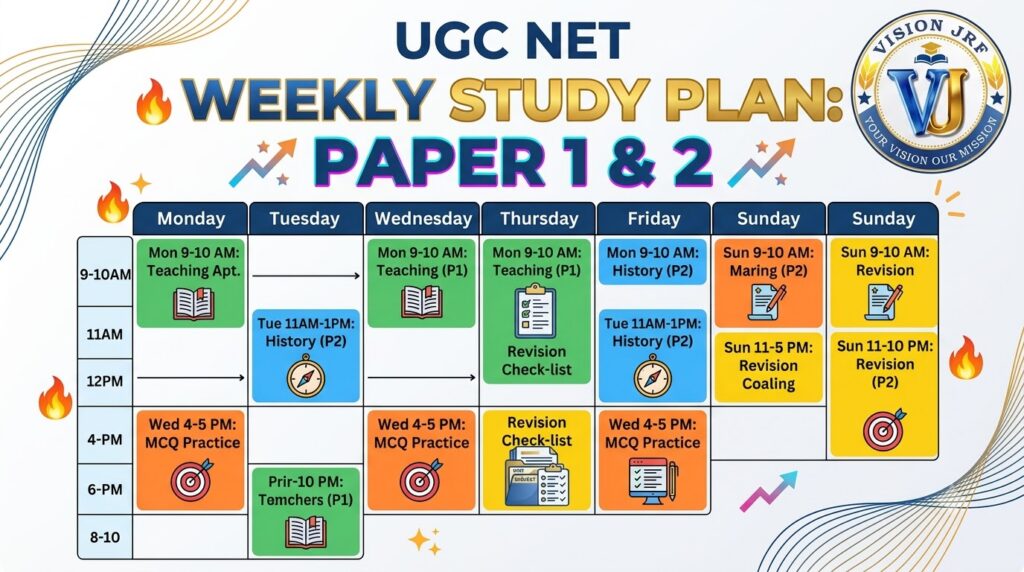

A practical UGC NET Study Plan to help you divide Paper 1 and Paper 2, manage your daily study time, practise questions, revise regularly and stay consistent until the exam.
What is UGC NET Exam?
Before we talk about UGC NET preparation, study plans, books or daily timetables, you should first understand what the UGC NET exam actually is. Once you know the exam structure, number of questions, marks and time available, it becomes much easier to plan your preparation.
UGC NET stands for University Grants Commission National Eligibility Test. It is conducted by the National Testing Agency (NTA) on behalf of UGC.
The examination determines eligibility for different academic routes, including:
- Junior Research Fellowship (JRF)
- Assistant Professor
- Assistant Professor and PhD admission
- PhD admission only
A candidate’s final eligibility category is determined by their exam scores along with the current UGC NET guidelines. So, before making your preparation plan, let us first understand the UGC NET exam pattern.

UGC NET Exam Pattern
Here is the complete UGC NET exam pattern in one view. Once you understand this table, you will have a clear idea of what you are preparing for.
| UGC NET Exam Pattern | Paper 1 (Part I) | Paper 2 (Part II) | Total |
| What it tests | Teaching and research aptitude, reasoning, comprehension and general awareness | Your chosen subject | Two papers |
| Number of questions | 50 | 100 | 150 |
| Marks | 100 | 200 | 300 |
| Marks per question | 2 | 2 | 2 |
| Question type | Multiple choice | Multiple choice | Objective |
| Duration | One combined test | One combined test | 180 minutes |
| Break between papers | No | No | No break |
| Negative marking | None | None | None |
| Compulsory? | All questions | All questions | Yes |
The important thing to understand here is that Paper 1 and Paper 2 are taken together in one examination. You get a total of 180 minutes, so your preparation should not focus only on completing the syllabus. You also need to develop the habit of solving questions within the available time.
UGC NET Study Planning
Now that you understand the UGC NET exam pattern, the next step is to understand what your preparation actually needs to cover. Your study plan should match the exam. You have to prepare for both Paper 1 and Paper 2, practise questions, revise regularly and take tests.
Here are the important exam facts you should keep in mind while making your study plan.
| UGC NET Study Plan: Exam Facts | Details |
| Format | One computer-based test of 3 hours with no break |
| Paper 1 | 50 questions, 100 marks |
| Paper 2 | 100 questions, 200 marks based on your chosen subject |
| Total | 150 questions, 300 marks |
| Marking | 2 marks for each correct answer, no negative marking |
| Minimum marks | 40% for General/EWS and 35% for reserved categories, in both papers together |
These points are important because your timetable should give enough time to learn, practise and revise both papers.
Design Your UGC NET Study Plan in 5 Steps
You do not need a complicated timetable. Start with these five steps.
1. Understand the Syllabus
First, go through the syllabus of Paper 1 and your Paper 2 subject.
Write down every unit and topic. This will help you see the complete syllabus instead of studying randomly.
2. Divide Topics into Strong, Average and Weak
Look at each unit and ask yourself:
- Which topics do I already understand?
- Which topics need more practice?
- Which topics are completely new to me?
Mark them as Strong, Average or Weak.
This simple exercise will help you decide where you need to spend more time.
3. Decide How Many Hours You Can Study
Do not copy someone else’s 10-hour or 12-hour timetable just because they are preparing for UGC NET.
First decide how much time you can realistically study every day.
For example:
- Working or college student: around 3 hours
- Full-time preparation: around 6 hours
- Very busy schedule: start with 2 focused hours
The important thing is not only the number of hours. Consistency matters more than making a very long timetable that you cannot follow.
4. Keep Your Plan Around the Exam
Once you know your available time, divide it between:
- Learning new topics
- Paper 1 preparation
- Paper 2 preparation
- Previous-year questions
- Revision
- Mock tests
Also keep checking the latest official exam information so that your plan matches the current examination schedule.
5. Test Yourself Regularly
Do not wait until the last month to start solving questions.
Take a short test every week and a full mock test regularly. After every test, check your mistakes and write down the topics where you need improvement.
This will show you whether your preparation is actually moving forward.
UGC NET Study Plan 4-Week Learning Study Cycle
A simple way to organise your preparation is to work in four-week cycles.
Instead of studying for months without checking your progress, divide your preparation into four stages:
Learn, Practise, Test and Review.
| UGC NET Study Plan: 4-Week Cycle | Focus | What You Should Do |
| Week 1: Learn | New topics | Study the selected units and make short notes |
| Week 2: Practise | Questions | Solve practice questions and previous-year questions |
| Week 3: Test | Testing | Take timed tests and check your mistakes |
| Week 4: Review | Revision | Revise notes, fix weak areas and plan the next cycle |
For example, suppose you are studying two units of your Paper 2 subject.
In Week 1, you understand the concepts and make notes.
In Week 2, you solve questions from those topics.
In Week 3, you take a timed test.
In Week 4, you check your mistakes and revise the topics where you lost marks.
Then you move to the next set of units. This keeps your preparation active instead of making it only about reading.
UGC NET Study Plan Weekly Timetable for Full-Time Students
If you are preparing for UGC NET full-time, you can aim for around 6 focused hours a day.
You do not have to follow these exact timings. The purpose is to give you a basic structure that you can adjust according to your routine.
| UGC NET Full-Time Daily Timetable | Time | Activity |
| Morning | 2.5 hours | Paper 2: New topic and notes |
| Late morning | 1 hour | Paper 1: Unit study or reasoning practice |
| Afternoon | 1 hour | Practice questions and previous-year questions |
| Evening | 1 hour | Revision and mistake log |
| Night | 30 minutes | Light reading, important terms or comprehension practice |
The main idea is simple: give more time to Paper 2, but do not ignore Paper 1.
You can change the order according to your most productive study time. If you concentrate better in the morning, use that time for difficult topics.
UGC NET Study Plan Weekly Timetable for Part-Time Students
Many UGC NET aspirants prepare while attending college, working or managing other responsibilities.
If you have around 3 hours a day, you can still create a proper routine. The key is to protect those three hours and use them consistently.
| UGC NET Part-Time Weekly Timetable | Focus | Time |
| Monday & Wednesday | Paper 2 topics | 2 hours Paper 2 + 1 hour Paper 1 |
| Tuesday & Thursday | Paper 1 and Paper 2 revision | 2 hours Paper 1 + 1 hour Paper 2 |
| Friday | Practice questions and previous-year questions | 3 hours |
| Saturday | Timed test and mistake analysis | 3–4 hours |
| Sunday | Revision and planning | 2–3 hours |
You do not need to study for long hours every day to make progress. Even with a part-time schedule, regular study, question practice and revision can keep your preparation moving forward.
The next step is to decide how to divide your Paper 2 units, because Paper 2 carries 200 marks and the syllabus can be different for every subject.
UGC NET Study Plan Rotate Your Paper 2 Units
Your Paper 2 syllabus is divided into units according to your chosen subject. So, before starting your preparation, check the official syllabus and list all the units.
Now give each unit a proper place in your study plan.
For example, if you have completed one unit, do not keep studying the same unit again and again. Move to the next unit and come back during revision.
A simple approach is:
- Give more time to weak units.
- Keep revisiting average units through practice.
- Revise strong units at regular intervals so that you do not forget them.
- Use previous-year questions to check how well you actually understand each unit.
You can use the 4-week cycle for this. Give each group of units a learning week, a practice week, a testing week and a revision week.
The number of units is different for different Paper 2 subjects, so check the official syllabus for your particular subject before making the final timetable.
UGC NET Study Plan Week, Day by Day
Now let’s see how you can combine Paper 1 and Paper 2 during a normal week.
The idea is simple: do not spend the entire week on Paper 2 and then leave Paper 1 for the last few weeks. Give both papers regular time from the beginning.
| UGC NET Study Plan: Sample Week | Paper 1 Task | Paper 2 Task |
| Day 1 | Teaching Aptitude notes | New Paper 2 unit, first half |
| Day 2 | Research Aptitude notes | New Paper 2 unit, second half |
| Day |
UGC NET Study Routine Healthy
A study plan is useful only when you can actually follow it.
You do not need to study for 10 or 12 hours every day. What matters is that you can sit down regularly and study with focus.
Try to:
- Get enough sleep.
- Take short breaks during long study sessions.
- Keep some time for rest every week.
- Avoid studying for very long hours when you are too tired to concentrate.
Remember, six focused hours are more useful than ten tired hours where you are only sitting with your books.
Your aim should be to build a routine that you can continue for several months.
UGC NET Study Plan Based Available Time
Not every student gets the same amount of preparation time. Someone may have one year, while another student may have only three or six months. So your study plan should depend on the time available to you.
Here is a simple structure you can use:
| UGC NET Study Plan by Duration | Phase 1: Learn | Phase 2: Practise | Phase 3: Test & Revise |
| 12 months | Months 1–6: Cover every unit | Months 7–10: Practise and solve previous-year questions | Months 11–12: Mock tests and revision |
| 6 months | Months 1–3: Cover every unit | Months 4–5: Practise and take tests | Month 6: Mock tests and revision |
| 3 months | Weeks 1–6: Cover the core units | Weeks 7–10: Practise and take tests | Weeks 11–12: Mock tests and revision |
This is only a basic framework. You can adjust it according to your Paper 2 subject, current preparation level and the amount of time you can study each day.
If you have less time, do not try to study everything at the same depth from day one. First understand your syllabus, identify important areas and then use your practice tests to find where you need more work.
UGC NET Study Plan Monthly Checklist
At the end of every month, spend some time checking your progress.
Ask yourself:
- Did I complete the units I planned for this month?
- Are my test scores improving?
- Which three units caused me the most problems?
- Is my Paper 1 accuracy improving?
- Which topics do I need to revise again?
- Do I need to change my timetable for the next month?
Do not judge your preparation only by the number of hours you studied.
Look at what you completed, how you performed in tests and where you are still making mistakes.
That will give you a much clearer picture of your progress.
UGC NET Study Plan Miss Study Days
Missing a day does not mean you need to throw away your entire timetable.
It happens. You may have college work, a job, family responsibilities or simply a bad day.
The important thing is how you return to your routine.
Follow a simple catch-up rule:
- Do not double your study hours the next day. Simply return to your normal timetable.
- If you miss several days, remove the least important task from that week’s plan instead of trying to complete everything at once.
- Keep your weekly test and review session. These will help you understand where you currently stand.
- Start again immediately. Do not wait for Monday or the beginning of a new month.
The biggest problem is often not missing one day. The problem is turning one missed day into one missed week.
UGC NET Study Plan Common Mistakes
While preparing for UGC NET, students often make some simple mistakes that can affect their progress.
1. Making a Timetable You Cannot Follow
A timetable may look impressive on paper, but if it requires more hours than you actually have, you will struggle to follow it.
Start with a realistic schedule and increase your study time only when you can manage it comfortably.
2. Studying Without Testing
Reading your notes for hours can feel productive, but it does not always tell you whether you can answer exam questions.
Include regular practice and tests in your preparation.
3. Ignoring Paper 1
Paper 1 should not be left for the end of your preparation.
Give it regular time along with Paper 2 so that you do not have to cover the entire paper at the last minute.
4. Changing Books and Sources Too Often
Using a new book or teacher every few days can create confusion.
Choose reliable study material and give yourself enough time to complete and revise it before looking for another source.
5. Not Keeping Time for Revision
Finishing a topic once does not mean you will remember it until the exam.
Keep regular revision sessions in your timetable. Your notes should be revised more than once, especially for topics where you repeatedly make mistakes.
Final Thoughts
Your UGC NET preparation does not need to be perfect from Day 1. Start with a realistic timetable, cover the syllabus step by step, practise questions regularly and keep checking your mistakes.
- If you miss a day, come back the next day.
- If your test score is low, find out why.
- If a topic is weak, give it another cycle.
- The goal is not to follow a perfect timetable. The goal is to keep improving until you are ready for the exam.