


The UGC NET exam is one of the major national-level exams for candidates who want to build a career in teaching, research, or higher education. Conducted by the National Testing Agency (NTA) on behalf of the University Grants Commission (UGC), the exam determines eligibility for Junior Research Fellowship (JRF), Assistant Professor, and PhD admission, as applicable.
UGC NET Qualification 2026 latest rules
For UGC NET, the first thing to check is your UGC NET Qualification. Your postgraduate marks, category, age, degree type and the purpose for which you want to qualify all matter.
For the latest 2026 rules, candidates with a Master’s degree or equivalent generally need 55% marks if they belong to the General or General-EWS category. Candidates belonging to OBC-NCL, SC, ST, PwD/PwBD or third gender categories generally need 50% marks. The marks are counted without rounding off.
UGC NET also offers a distinct pathway for candidates holding a four-year bachelor’s degree. These candidates are permitted to sit for the exam once they meet the specified marks threshold, though qualifying through this pathway only opens the door to JRF and PhD admission, it does not extend to Assistant Professor eligibility.
Regarding age criteria, the June 2026 information bulletin set the JRF upper age ceiling at 30 years, calculated as on 1 June 2026, with age relaxations available to specified categories. By contrast, candidates pursuing Assistant Professor eligibility or PhD admission face no such age restriction.
Latest update: The information below follows the UGC-NET June 2026 Information Bulletin. Candidates applying for a future cycle should check the latest NTA notification because dates, rules or other details can be changed through a new bulletin.

What Is UGC NET Qualification?
UGC NET Qualification means meeting the educational, marks and other eligibility conditions required to appear for the University Grants CommissionNational Eligibility Test.
The National Testing Agency (NTA) administers UGC NET under the authority of the University Grants Commission (UGC). The examination can lead to eligibility for different academic routes, depending on the category in which a candidate qualifies.
A candidate may qualify for:
- Junior Research Fellowship (JRF) and Assistant Professor
- Assistant Professor and PhD admission
- PhD admission only
The qualification category is decided on the basis of the candidate’s performance in the UGC NET examination.
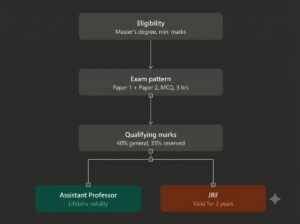
UGC NET Qualification overview
Eligibility leads into the exam, the exam score gets checked against the qualifying marks, and clearing that splits into the two outcomes.
| Eligibility Factor | UGC NET 2026 Requirement |
| Master’s degree | Required for the regular postgraduate route |
| General/EWS marks | Minimum 55% |
| OBC-NCL/SC/ST/PwD/PwBD/Third Gender | Minimum 50% |
| Four-year bachelor’s degree | Minimum 75% |
| Relaxation for eligible categories in four-year degree | 5% |
| JRF upper age | 30 years |
| Assistant Professor upper age | No upper age limit |
| PhD admission upper age | No upper age limit |
| Final-year Master’s students | Can apply provisionally |
| Final-year four-year degree students | Can apply provisionally |
| Attempts | No separate maximum-attempt limit specified in the June 2026 eligibility rules |
UGC NET Qualification Master’s Degree Requirement
For the regular UGC NET qualification route, candidates need a Master’s degree or an equivalent qualification from a university or institution recognised by UGC.
For the examination, the minimum marks were:
| Category | Minimum Marks in Master’s Degree |
| General / Unreserved | 55% |
| General-EWS | 55% |
| OBC-NCL | 50% |
| SC | 50% |
| ST | 50% |
| PwD / PwBD | 50% |
| Third Gender | 50% |
The marks must be obtained without rounding off. This means a candidate who has 54.9% cannot treat it as 55%. Similarly, 49.9% cannot be treated as 50%.
Which Master’s Subject Should You Choose?
Candidates are advised to appear in the UGC NET subject related to their postgraduate subject.
- If the candidate’s postgraduate subject is not included in the list of UGC NET subjects, the bulletin allows the candidate to appear in a related subject.
- For example, if your Master’s subject is included in the UGC NET subject list, you should normally select that subject rather than choosing a completely unrelated subject.
UGC NET Qualification Final-Year Master’s Students
You do not necessarily have to wait for your final Master’s result before applying.
Candidates who are:
- pursuing their Master’s degree,
- appearing in the final year examination,
- waiting for their Master’s result, or
- facing a delay in their qualifying examination
can apply provisionally for UGC NET.
However, there is an important condition.
Such candidates must eventually complete their Master’s degree with the required percentage. For candidates qualifying for JRF or Assistant Professor eligibility, the Master’s degree must be completed within two years from the date of the NET result.
Candidates qualifying only for PhD admission have to complete the Master’s degree within one year from the date of the NET result. If the required qualification is not completed within the applicable period, the candidate can be treated as disqualified.
Simple Example
Suppose a student is appearing for the final semester of an MA degree when the UGC NET application opens.
- The student can apply for the examination even though the MA result has not been declared yet. But simply appearing in UGC NET is not enough.
- The student must later complete the Master’s qualification with the required marks within the prescribed period.
UGC NET Qualification Four-Year Bachelor’s Degree
UGC NET also has a separate eligibility route for candidates who have completed a four-year or eight-semester bachelor’s degree programme.
- Such candidates need at least 75% marks in aggregate, or an equivalent grade where the grading system is used.
- A 5% relaxation may be available to eligible categories such as SC, ST, OBC-NCL, differently-abled candidates, EWS and other categories as specified by the Commission. But there is one very important point.
What Can You Do After UGC NET with a Four-Year Degree?
Candidates qualifying through the four-year undergraduate degree route can be eligible for:
- JRF
- PhD admission
They cannot use a four-year bachelor’s degree alone to become eligible for appointment as Assistant Professor through UGC NET.
Can Final-Year Four-Year Degree Students Apply?
Yes, Students who are in the final semester or final year of a four-year or eight-semester bachelor’s degree can also apply provisionally.
However, they have to fulfil the required conditions within the prescribed period after the NET result. For JRF, the applicable period is two years, while candidates qualifying for PhD admission only have one year.
UGC NET Qualification for JRF
JRF has an additional age condition that does not apply to Assistant Professor or PhD admission.
The candidate must not be more than 30 years old as on the cut-off date prescribed for the relevant UGC NET examination cycle.
Certain candidates can receive age relaxation under the rules. Up to five years of relaxation is provided for:
- OBC-NCL candidates
- SC candidates
- ST candidates
- PwD/PwBD candidates
- Third gender candidates
- Women applicants
Additional relaxation provisions are also available for eligible candidates with research experience, LLM qualification or armed forces service, subject to the conditions and overall limits specified in the applicable notification/bulletin.
UGC NET JRF Age Relaxation
| Category / Condition | Relaxation |
| OBC-NCL | Up to 5 years |
| SC / ST | Up to 5 years |
| PwD / PwBD | Up to 5 years |
| Third Gender | Up to 5 years |
| Women candidates | Up to 5 years |
| Research experience | Up to 5 years, subject to rules |
| LLM degree | 3 years |
| Armed forces service | Up to 5 years, subject to rules |
UGC NET Qualification for Assistant Professor
There is no upper age limit for applying for UGC NET for Assistant Professor eligibility.
- However, clearing UGC NET does not itself mean that a candidate is automatically appointed as an Assistant Professor.
- Recruitment is governed by the rules of the concerned university, college, institution or state government, as applicable.
- For candidates using the regular Master’s degree route, the required postgraduate qualification and NET eligibility conditions must be met.
- Candidates who qualify through the four-year bachelor’s degree route should remember that this route does not make them eligible for Assistant Professor appointment.
UGC NET Qualification for PhD Admission
There is also no upper age limit for applying to UGC NET for PhD admission.
The UGC NET qualification structure has three categories:
| UGC NET Category | JRF | Assistant Professor | PhD Admission |
| Category 1 | Yes | Yes | Yes |
| Category 2 | No | Yes | Yes |
| Category 3 | No | No | Yes |
For Category 2 and Category 3 candidates, UGC NET marks can be used as part of the PhD admission process. Under the prescribed eligibility norms, NET marks carry 70% weightage, while the university or higher educational institution interview carries 30% weightage.
The NET marks for these PhD admission categories remain valid for one year from the date of declaration of the UGC NET result.
UGC NET Qualification for Reserved Categories
Reserved category candidates receive relaxation in the minimum marks requirement.
- For the Master’s degree route, OBC-NCL, SC, ST, PwD/PwBD and third gender candidates are required to secure 50% marks under the prescribed eligibility norms.
- General and General-EWS candidates require 55%.
- Candidates should be careful while selecting their category in the application form.
- For example, an OBC candidate whose caste is listed only in a State OBC list but not in the Central OBC-NCL list cannot simply select OBC-NCL for UGC NET.
- Candidates must use the Central List for determining OBC-NCL status, as prescribed under the UGC NET eligibility norms.
UGC NET Qualification for PwD/PwBD Candidates
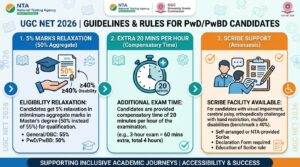
PwD/PwBD candidates can receive the applicable relaxation in the qualifying marks.
- For the Master’s degree route, PwD/PwBD candidates are required to secure 50% marks under the prescribed eligibility norms.
- The examination also provides accessibility-related provisions for eligible candidates, including scribe facilities in applicable cases. The exact facility depends on the candidate’s disability and the conditions prescribed by the examination authority.
- Candidates should carefully read the latest instructions regarding disability certificates, scribe requirements and examination support before applying.
UGC NET Qualification for Third Gender Candidates
Third gender candidates receive the same relaxation in fee, age and eligibility criteria as applicable to SC/ST/PwD/PwBD categories under the prescribed UGC NET eligibility norms.
- For the Master’s degree qualification, the required minimum marks are 50%.
- The subject-wise qualifying cut-off for the third gender category is determined according to the rule specified in the applicable notification/bulletin.
UGC NET Qualification for PhD Holders
There is a special relaxation for certain PhD holders.
- Candidates who completed their Master’s-level examination by 19 September 1991, irrespective of the date on which their result was declared, are eligible for a 5% relaxation in aggregate marks for appearing in UGC NET.
- Therefore, the required Master’s-level percentage is reduced from 55% to 50% under this specific provision.
- This is a special provision, so candidates should check whether they actually satisfy the date and qualification conditions before claiming it.
UGC NET Qualification For Foreign Degree
Candidates who have obtained a qualification from a foreign educational institution need to pay special attention to equivalence.
- Candidates holding foreign qualifications are advised to obtain equivalence from the University Grants Commission (UGC), as required under the UGC NET eligibility norms.
- This is governed by the UGC Regulations on Recognition and Grant of Equivalence to Qualifications Obtained from Foreign Educational Institutions, 2025.
- If a candidate has a postgraduate diploma awarded by an Indian institute, the candidate should check its equivalence with a Master’s degree through the Association of Indian Universities (AIU), where applicable.
UGC NET Qualification, Assistant Professor Exemption
NET, SET or SLET remains the minimum eligibility condition for Assistant Professor recruitment, subject to exemptions provided under applicable UGC regulations.
- Candidates holding foreign qualifications are advised to obtain equivalence from the University Grants Commission (UGC), as required under the UGC NET eligibility norms.
- This is governed by the UGC Regulations on Recognition and Grant of Equivalence to Qualifications Obtained from Foreign Educational Institutions, 2025.
- If a candidate has a postgraduate diploma awarded by an Indian institute, the candidate should check its equivalence with a Master’s degree through the Association of Indian Universities (AIU), where applicable.
UGC NET Attempt Limit
The eligibility section does not prescribe a separate maximum number of attempts for UGC NET.
- This means candidates can appear in subsequent examination cycles if they continue to satisfy the applicable eligibility conditions.
- However, candidates applying for JRF must satisfy the age requirement applicable to that examination cycle. Assistant Professor and PhD admission categories do not have an upper age limit.
UGC NET Qualification Difference Between Degree Routes
One of the most common sources of confusion is the difference between a Master’s degree and a four-year bachelor’s degree.
| Qualification Route | Minimum Marks | JRF | PhD | Assistant Professor |
| Master’s degree | 55% General/EWS | Yes | Yes | Yes, subject to applicable rules |
| Master’s degree | 50% eligible reserved categories | Yes | Yes | Yes, subject to applicable rules |
| Four-year bachelor’s degree | 75% | Yes | Yes | No |
| Four-year bachelor’s degree with eligible relaxation | 70% | Yes | Yes | No |
The four-year degree route is therefore useful for candidates targeting JRF or PhD admission, but it should not be confused with the Master’s degree route for Assistant Professor eligibility.
UGC NET Qualification Documents and Verification
Candidates do not have to send their eligibility certificates or other supporting documents to NTA along with the application form.
However, this does not mean that eligibility is automatically verified during registration.
The June 2026 bulletin makes it clear that candidates are responsible for checking their own eligibility. If a candidate is later found to be ineligible, the candidature can be cancelled and further action may follow under the applicable rules.
So, before submitting the form, check:
- Your degree and university.
- Your final percentage.
- Your category.
- Your age, if applying for JRF.
- Your postgraduate subject.
- Whether your qualification is recognised.
- Whether you need equivalence for a foreign qualification.
- Whether you are using the four-year bachelor’s degree route.
UGC NET Qualification Checklist for Students
You can use this simple checklist before applying:
Step 1: Check your highest qualification.
Step 2: If you have a Master’s degree, check whether you have 55% or the applicable 50% requirement.
Step 3: If you have a four-year bachelor’s degree, check whether you meet the 75% requirement or applicable relaxation.
Step 4: Decide your target JRF, Assistant Professor, PhD admission or a combination where permitted.
Step 5: If you are applying for JRF, check your age on the applicable cut-off date.
Step 6: Check whether your postgraduate subject is available as a UGC NET subject.
Step 7: If your qualification is from outside India, check the UGC equivalence requirement.
Step 8: Check your category certificate and ensure that your category is correctly applicable.
UGC NET Eligibility Myths Clarified
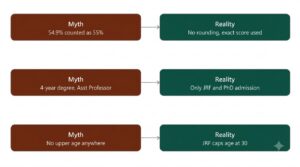
Even with a detailed bulletin in hand, a few misconceptions keep tripping up NET aspirants year after year here’s where each one falls apart.
Treating 54.9% as 55%
UGC NET eligibility marks are calculated without any rounding off. A candidate scoring 54.9% cannot claim to meet the 55% requirement.
Assuming a Four-Year Degree Automatically Qualifies for Assistant Professor
A four-year bachelor’s degree can open the route to JRF and PhD admission, but on its own it does not make a candidate eligible for Assistant Professor appointment through UGC NET.
Overlooking the JRF Age Limit
There is no upper age limit for Assistant Professor eligibility or PhD admission, but JRF comes with an age limit, subject to the prescribed relaxations.
Selecting the State OBC List Instead of the Central OBC-NCL List
Before selecting OBC-NCL in the UGC NET application, candidates should verify their caste is included in the Central OBC-NCL list a State OBC listing alone is not sufficient.
Assuming Final-Year Students Are Automatically Eligible
Final-year students can apply provisionally, but they must still complete their qualification with the prescribed marks within the applicable time limit.
UGC NET Qualification Final Takeaway
The basic UGC NET Qualification depends mainly on your educational qualification, marks, category and the route you want to pursue.
- For the regular Master’s degree route, the June 2026 rules require 55% marks for General/EWS candidates and 50% for specified reserved categories. Final-year Master’s students can also apply provisionally.
- Candidates with a four-year bachelor’s degree have a separate route requiring 75% marks, with applicable relaxation for eligible categories. However, this route is for JRF and PhD admission, not Assistant Professor appointment.
- For JRF, the June 2026 upper age limit was 30 years as on 1 June 2026, with specified relaxations. There is no upper age limit for Assistant Professor or PhD admission.
- The most important thing is to check your qualification carefully before applying. A small mistake in marks, category, degree type or age can affect your eligibility.