

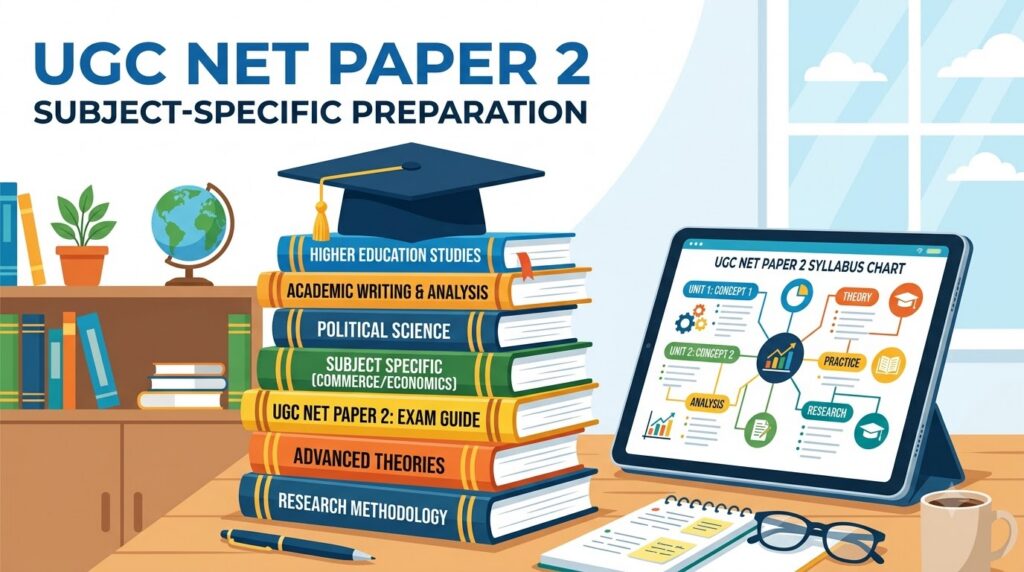

The UGC NET Paper 2 syllabus is based on the subject selected by the candidate. Unlike Paper 1, which is common for everyone, Paper 2 checks your subject-specific knowledge. It carries 100 questions for 200 marks, with 2 marks for each question. The current NTA examination information also confirms that Paper 2 is based on the candidate’s selected subject
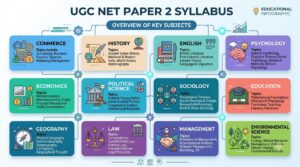
UGC provides separate syllabi for different NET subjects. The official UGC syllabus page currently lists subjects such as History, Political Science, Commerce, English, Hindi, Geography, Education, Economics, Sociology, Computer Science, Environmental Sciences and many others
UGC NET Exam Pattern
the whole UGC NET exam pattern in one view. Read it once and you know the shape of the paper. The sections after it explain each row.
| UGC NET exam pattern 2026 | Paper 1 (Part I) | Paper 2 (Part II) | Total |
| What it tests | Teaching and research aptitude, reasoning, comprehension, general awareness | Your chosen subject | Two parts |
| Number of questions | 50 | 100 | 150 |
| Marks | 100 | 200 | 300 |
| Marks per question | 2 | 2 | 2 |
| Question type | Multiple choice | Multiple choice | Objective only |
| Duration | One combined test | One combined test | 180 minutes |
| Break between papers | No | No | No break |
| Negative marking | None | None | None |
| Compulsory? | All questions | All questions | Yes |
UGC NET Exam 87 Subjects
The UGC NET examination is conducted for subjects across various disciplines. Candidates can select their preferred subject while filling out the application form based on their educational qualification and the subjects available under UGC NET.
UGC NET subject codes and subject names
The table below provides the UGC NET subject codes and subject names.
| S. No. | Subject Code | Subject Name |
| 1 | 001 | Economics |
| 2 | 002 | Political Science |
| 3 | 003 | Philosophy |
| 4 | 004 | Psychology |
| 5 | 005 | Sociology |
| 6 | 006 | History |
| 7 | 007 | Anthropology |
| 8 | 008 | Commerce |
| 9 | 009 | Education |
| 10 | 010 | Social Work |
| 11 | 011 | Defence and Strategic Studies |
| 12 | 012 | Home Science |
| 13 | 014 | Public Administration |
| 14 | 015 | Population Studies |
| 15 | 016 | Music |
| 16 | 017 | Management |
| 17 | 018 | Maithili |
| 18 | 019 | Bengali |
| 19 | 020 | Hindi |
| 20 | 021 | Kannada |
| 21 | 022 | Malayalam |
| 22 | 023 | Odia |
| 23 | 024 | Punjabi |
| 24 | 025 | Sanskrit |
| 25 | 026 | Tamil |
| 26 | 027 | Telugu |
| 27 | 028 | Urdu |
| 28 | 029 | Arabic |
| 29 | 030 | English |
| 30 | 031 | Linguistics |
| 31 | 032 | Chinese |
| 32 | 033 | Dogri |
| 33 | 034 | Nepali |
| 34 | 035 | Manipuri |
| 35 | 036 | Assamese |
| 36 | 037 | Gujarati |
| 37 | 038 | Marathi |
| 38 | 039 | French |
| 39 | 040 | Spanish |
| 40 | 041 | Russian |
| 41 | 042 | Persian |
| 42 | 043 | Rajasthani |
| 43 | 044 | German |
| 44 | 045 | Japanese |
| 45 | 046 | Adult Education |
| 46 | 047 | Physical Education |
| 47 | 049 | Arab Culture and Islamic Studies |
| 48 | 050 | Indian Culture |
| 49 | 055 | Labour Welfare / HRM |
| 50 | 058 | Law |
| 51 | 059 | Library and Information Science |
| 52 | 060 | Buddhist, Jaina and Gandhian Studies |
| 53 | 062 | Comparative Study of Religions |
| 54 | 063 | Mass Communication and Journalism |
| 55 | 065 | Performing Arts |
| 56 | 066 | Museology and Conservation |
| 57 | 067 | Archaeology |
| 58 | 068 | Criminology |
| 59 | 070 | Tribal and Regional Language |
| 60 | 071 | Folk Literature |
| 61 | 072 | Comparative Literature |
| 62 | 073 | Sanskrit Traditional Subjects |
| 63 | 074 | Women Studies |
| 64 | 079 | Visual Art |
| 65 | 080 | Geography |
| 66 | 081 | Social Medicine and Community Health |
| 67 | 082 | Forensic Science |
| 68 | 083 | Pali |
| 69 | 084 | Kashmiri |
| 70 | 085 | Konkani |
| 71 | 087 | Computer Science and Applications |
| 72 | 088 | Electronic Science |
| 73 | 089 | Environmental Sciences |
| 74 | 090 | Politics (International Relations) |
| 75 | 091 | Prakrit |
| 76 | 092 | Human Rights and Duties |
| 77 | 093 | Tourism Administration and Management |
| 78 | 094 | Bodo |
| 79 | 095 | Santali |
| 80 | 100 | Yoga |
| 81 | 101 | Sindhi |
| 82 | 102 | Hindu Studies |
| 83 | 103 | Indian Knowledge System |
| 84 | 104 | Disaster Management |
| 85 | 105 | Ayurveda Biology |
| 86 | 106 | Forestry |
| 87 | 107 | Statistics |
UGC NET Paper 2 Subject-Wise Syllabus Official Syllabus
The bulletin says syllabi for all subjects are on the UGC syllabus page, ugcnetonline.in, and NTA will not send them to any candidate. Each subject has a PDF, mostly in English and Hindi. Follow these steps.
- Open the official NTA UGC NET site and read the current bulletin. Section 2.3 names the syllabus page.
- Open that UGC syllabus page and pick your subject by name and code.
- Download the Paper 1 PDF (code 00) and your Paper 2 PDF.
- Check the cycle and date on the source. Old PDFs and old blog posts still circulate.
Updated Syllabi of UGC-NET (Applicable from June 2019 UGC-NET Onwards)
The subjects with their respective codes are given below :
| Code | Subject | English PDF | Hindi PDF |
| 00 | Paper 1 (General Paper) | English | Hindi |
| 01 | Economics / Rural Economics / Co-operation / Demography / Development Planning / Development Studies / Econometrics / Applied Economics / Development Eco. / Business Economics | English | Hindi |
| 02 | Political Science | English | Hindi |
| 03 | Philosophy | English | Hindi |
| 04 | Psychology | English | Hindi |
| 05 | Sociology | English | Hindi |
| 06 | History | English | Hindi |
| 07 | Anthropology | English | Hindi |
| 08 | Commerce | English | Hindi |
| 09 | Education | English | Hindi |
| 10 | Social Work | English | Hindi |
| 11 | Defence and Strategic Studies | English | Hindi |
| 12 | Home Science | English | Hindi |
| 14 | Public Administration | English | Hindi |
| 15 | Population Studies | English | Hindi |
| 16 | Music | English | Hindi |
| 17 | Management (Business Admn. / Marketing / Industrial Relations / Personnel Mgt. / Financial Mgt. / Co-operative Mgt.) | English | Hindi |
| 18 | Maithili | Maithili | Same |
| 19 | Bengali | Bengali | Same |
| 20 | Hindi | — | Hindi |
| 21 | Kannada | Kannada | Same |
| 22 | Malayalam | Malayalam | Same |
| 23 | Odia | Odia | Same |
| 24 | Punjabi | Punjabi | Same |
| 25 | Sanskrit | English | Hindi |
| 26 | Tamil | Tamil | Same |
| 27 | Telugu | Telugu | Same |
| 28 | Urdu | Urdu | Same |
| 29 | Arabic | Arabic | Same |
| 30 | English | English | Same |
| 31 | Linguistics | English | Hindi |
| 32 | Chinese | Chinese | Same |
| 33 | Dogri | Dogri | Same |
| 34 | Nepali | Nepali | Same |
| 35 | Manipuri | Manipuri | Same |
| 36 | Assamese | Assamese | Same |
| 37 | Gujarati | Gujarati | Same |
| 38 | Marathi | Marathi | Same |
| 39 | French | English | French |
| 40 | Spanish | Spanish | Same |
| 41 | Russian | English | Russian |
| 42 | Persian | Persian | Same |
| 43 | Rajasthani | Hindi | Same |
| 44 | German | German | Same |
| 45 | Japanese | Japanese | Same |
| 46 | Adult Education / Continuing Education / Andragogy / Non-Formal Education | English | Hindi |
| 47 | Physical Education | English | Hindi |
| 49 | Arab Culture and Islamic Studies | English | Hindi |
| 50 | Indian Culture | English | Hindi |
| 55 | Labour Welfare / Personnel Mgt. / Industrial Relations / HRM | English | Hindi |
| 58 | Law | English | Hindi |
| 59 | Library and Information Science | English | Hindi |
| 60 | Buddhist, Jaina, Gandhian and Peace Studies | English | Hindi |
| 62 | Comparative Study of Religions | English | Hindi |
| 63 | Mass Communication and Journalism | English | Hindi |
| 65 | Performing Art — Dance / Drama / Theatre | English | Hindi |
| 66 | Museology and Conservation | English | Hindi |
| 67 | Archaeology | English | Hindi |
| 68 | Criminology | English | Hindi |
| 70 | Tribal and Regional Language / Literature | English | Hindi |
| 71 | Folk Literature | English | Hindi |
| 72 | Comparative Literature | English | Hindi |
| 73 | Sanskrit Traditional Subjects (Jyotisha, Vyakarna, Mimansa, Nyaya, etc.) | — | Hindi |
| 74 | Women Studies | English | Hindi |
| 79 | Visual Art (Drawing/Painting, Sculpture, Applied Art, History of Art) | English | Hindi |
| 80 | Geography | English | Hindi |
| 81 | Social Medicine and Community Health | English | Hindi |
| 82 | Forensic Science | English | Hindi |
| 83 | Pali | English | Hindi |
| 84 | Kashmiri | Kashmiri | Same |
| 85 | Konkani | Konkani | Same |
| 87 | Computer Science and Applications | English | English only |
| 88 | Electronic Science | English | English only |
| 89 | Environmental Sciences | English | English only |
| 90 | Politics incl. International Relations / Area Studies (West Asian, South East Asian, African, South Asian, Soviet, American) | English | Hindi |
| 91 | Prakrit | English | Hindi |
| 92 | Human Rights and Duties | English | Hindi |
| 93 | Tourism Administration and Management | English | Hindi |
| 94 | Bodo | — | Hindi |
| 95 | Santali | — | Hindi |
| 100 | Yoga | English | Hindi |
| 101 | Sindhi | Arabic script | Hindi |
| 102 | Hindu Studies | English | Hindi |
| 103 | Indian Knowledge System | English | Hindi |
| 104 | Disaster Management | English | Hindi |
| 105 | Ayurveda Biology | English | Hindi |
| 106 | Forestry | English | Hindi |
| 107 | Statistics | English | Hindi |
UGC NET Exam Medium
Choosing your medium is an important step.
| UGC NET syllabus in Hindi: medium rules | What the bulletin says |
| Languages of the question paper | English and Hindi only, except language papers |
| When you choose | While filling the online application form |
| Can you change it? | No. The option once exercised cannot be changed |
| Language of your answers | You answer in the medium you chose in the form |
| If a question is unclear in translation | The English version is treated as final |
UGC NET History Syllabus 10 Units
The official History syllabus is divided into 10 units. These units cover Ancient India, Early Medieval India, Medieval India, Modern India, the Indian National Movement, post-independence developments, historical methodology and historiography.
| Unit | Main Area |
| Unit I | Sources and Early Indian History |
| Unit II | Mauryan to Gupta and Related Developments |
| Unit III | Early Medieval India |
| Unit IV | Medieval Indian History |
| Unit V | Medieval Administration and Economy |
| Unit VI | Medieval Society and Culture |
| Unit VII | Modern Indian History and British Expansion |
| Unit VIII | Colonial Economy and Indian Society |
| Unit IX | Indian National Movement and Post-Independence India |
| Unit X | Historical Method, Research Methodology and Historiography |
UGC NET History Paper 2 Syllabus
UGC NET History Paper 2 is based on History, Subject Code 06. The syllabus covers Indian history from prehistoric times to post-independence India. It also includes historical sources, culture, society, economy, political developments, research methodology and historiography. The official syllabus is divided into 10 units.
Below is the complete unit-wise syllabus in simple English.
Unit 1: Negotiating the Sources
This unit focuses on the different sources used to study ancient Indian history.
- Archaeological sources
- Exploration and excavation
- Epigraphy and inscriptions
- Numismatics and coins
- Dating of archaeological sites
- Literary sources
- Indigenous sources
- Religious and secular literature
- Primary and secondary sources
- Foreign accounts
- Greek, Chinese and Arabic accounts
- Neolithic and Chalcolithic cultures
- Settlement patterns
- Tools and technology
- Trade and exchange
- Harappan/Indus Valley Civilisation
- Origin and extent
- Important Harappan sites
- Society and polity
- Economy and trade
- Religion and culture
- Decline of the Harappan Civilisation
- First urbanisation
- Vedic and Later Vedic society
- Aryan debate
- Political and social structure
- Varna system
- Religious ideas and practices
- Iron technology
- Megalithic cultures of South India
- Mahajanapadas
- Monarchies and republics
- Second urbanisation
- Jainism
- Buddhism
- Ajivikas
Unit 2: From the Mauryan Empire to the Gupta Period
This unit covers major political, economic, social and cultural developments from the Mauryan period to the Gupta age.
- Rise of the Mauryan Empire
- Sources of Mauryan history
- Administration under the Mauryas
- Ashoka and his Dhamma
- Mauryan economy and society
- Mauryan art and architecture
- Post-Mauryan developments
- Indo-Greeks
- Shakas
- Kushanas
- Satavahanas
- Sangam age
- Early South Indian kingdoms
- Trade and commerce
- Urbanisation
- Development of art and architecture
- Religious developments
- Rise of Mahayana Buddhism
- Gupta Empire
- Gupta administration
- Economy and society
- Science and technology
- Literature
- Art and architecture
- Religion during the Gupta period
- Gupta and post-Gupta developments
Unit 3: Early Medieval India
This unit deals with the political and socio-economic changes in early medieval India.
- Sources for early medieval Indian history
- Regional kingdoms
- Pallavas
- Chalukyas
- Rashtrakutas
- Palas
- Pratiharas
- Cholas
- Rajput states
- State formation
- Administration
- Agrarian structure
- Land grants
- Peasants and rural society
- Trade and commerce
- Growth of towns
- Temple institutions
- Bhakti traditions
- Religious developments
- Art and architecture
- Education and literature
- South Indian society and economy
Unit 4: Medieval India
This unit covers the Delhi Sultanate and the major developments in medieval Indian society, economy, politics and culture.
- Sources of medieval Indian history
- Arab and Turkish invasions
- Establishment of the Delhi Sultanate
- Slave/Mamluk dynasty
- Khaljis
- Tughlaqs
- Sayyids
- Lodis
- Administration of the Sultanate
- Iqta system
- Revenue system
- Military organisation
- Agrarian relations
- Trade and commerce
- Urbanisation
- Social structure
- Position of women
- Sufi traditions
- Bhakti movement
- Regional kingdoms
- Vijayanagara Empire
- Bahmani Kingdom
- Mughal Empire
- Mughal administration
- Mansabdari system
- Jagirdari system
- Akbar’s religious policy
- Mughal economy
- Agriculture
- Trade
- Society and culture
- Mughal art and architecture
Unit 5: Medieval Indian Culture
This unit focuses on the cultural developments of medieval India.
- Religious traditions
- Sufism
- Bhakti movement
- Sikhism
- Development of regional languages
- Persian literature
- Sanskrit literature
- Medieval Indian architecture
- Indo-Islamic architecture
- Mughal architecture
- Painting traditions
- Music
- Literature
- Education
- Science and technology
- Development of towns
- Cultural interaction
- Composite cultural traditions
Unit 6: Modern India
This unit begins with the expansion of European powers in India and covers the colonial period.
- European trading companies
- Portuguese
- Dutch
- English
- French
- Establishment of British power
- Carnatic Wars
- Battle of Plassey
- Battle of Buxar
- Expansion of British rule
- Subsidiary Alliance
- Doctrine of Lapse
- British administrative system
- Economic impact of British rule
- Land revenue systems
- Permanent Settlement
- Ryotwari system
- Mahalwari system
- Commercialisation of agriculture
- Drain of wealth
- Deindustrialisation
- Development of railways and communication
- Tribal and peasant movements
- Revolt of 1857
- Causes and nature of the Revolt
- Consequences of 1857
- Social and religious reform movements
- Development of education
- Growth of nationalism
- Formation of the Indian National Congress
Unit 7: Indian National Movement
This unit covers the major stages of India’s freedom struggle.
- Rise of Indian nationalism
- Early nationalists
- Extremists
- Swadeshi and Boycott Movement
- Partition of Bengal
- Muslim League
- Home Rule Movement
- Gandhian era
- Champaran
- Kheda
- Ahmedabad Mill Strike
- Non-Cooperation Movement
- Civil Disobedience Movement
- Salt Satyagraha
- Quit India Movement
- Revolutionary movements
- Subhas Chandra Bose and INA
- Peasant movements
- Tribal movements
- Workers’ movements
- Dalit movements
- Women’s participation
- Constitutional developments
- Government of India Acts
- Simon Commission
- Round Table Conferences
- Communal politics
- Demand for Pakistan
- Cabinet Mission
- Independence and Partition
Unit 8: India After Independence
This unit deals with political, economic and social developments after 1947.
- Integration of princely states
- Making of the Constitution
- Indian Constitution
- Political developments
- Parliamentary democracy
- First General Election
- Development of political parties
- Centre-State relations
- Linguistic reorganisation of states
- Economic planning
- Five-Year Plans
- Mixed economy
- Industrialisation
- Agricultural development
- Green Revolution
- Social and economic changes
- Foreign policy
- Non-Aligned Movement
- India and neighbouring countries
- India and the Cold War
- Development of science and technology
- Education
- Social movements
- Emergency
- Post-Emergency political developments
Unit 9: Historical Concepts and Themes
This unit focuses on important concepts and themes used in the study of Indian history.
- State and society
- Kingship
- Administration
- Political institutions
- Social structure
- Caste
- Varna
- Gender
- Family
- Marriage
- Religion
- Philosophy
- Economy
- Agriculture
- Land relations
- Trade and commerce
- Urbanisation
- Technology
- Art and architecture
- Literature
- Education
- Science
- Environment
- Tribal societies
- Peasant societies
- Cultural traditions
- Regional identities
Unit 10: Historical Method, Research Methodology and Historiography
This unit is important for understanding how history is studied and written.
Historical Method
- Scope and importance of history
- Objectivity and bias
- Heuristics
- Criticism of historical sources
- Synthesis and presentation
- History and its auxiliary sciences
- History as science
- History as art
- History as a social science
- Causation in history
- Imagination in history
- Regional history
- Recent trends in Indian history
Research Methodology
- Research in history
- Hypothesis
- Selection of research topic
- Area of proposed research
- Data collection
- Primary and secondary sources
- Original and transit sources
- Historical research methods
- Notes taking
- References
- Footnotes
- Bibliography
- Thesis writing
- Assignment writing
- Plagiarism
- Intellectual dishonesty
- History writing
Historiography
- Greek historiography
- Roman historiography
- Church historiography
- Renaissance and history writing
- Positive and negative schools of historical writing
- Leopold von Ranke
- Marxist philosophy of history
- Scientific materialism
- Oswald Spengler
- Cyclical theory of history
- Arnold J. Toynbee
- Challenge and Response theory
- Postmodernism
- Recent Indian historiography
UGC NET Preparation Tips
Preparing for UGC NET requires a clear study plan, regular revision and consistent practice. Since the exam has both Paper 1 and Paper 2, candidates should give proper attention to both sections.
Understand the UGC NET Syllabus
Start by going through the complete syllabus of Paper 1 and Paper 2. Mark the topics that are important, familiar and difficult for you. This will help you organise your preparation and avoid spending too much time on topics that are less important.
Make a Realistic Study Plan
Create a daily or weekly timetable according to the time available before the examination. Divide your study hours between Paper 1, Paper 2, revision and practice tests.
A simple study routine can include:
| Preparation Area | Suggested Focus |
| Paper 1 | Daily concept-based study |
| Paper 2 | Major portion of daily study time |
| Previous Year Questions | Regular practice |
| Revision | Weekly revision |
| Mock Tests | Regular full-length practice |
Give More Time to Paper 2
Paper 2 carries 200 marks, so it is an important part of the overall examination. Focus on understanding the concepts rather than simply memorising information. Prepare each unit systematically and keep short notes for revision.
Do Not Ignore Paper 1
Although Paper 1 is common to all candidates, it should not be left for the last few weeks. Prepare topics such as Teaching Aptitude, Research Aptitude, Reasoning, Data Interpretation, Communication and ICT regularly.
Solve Previous Year Questions
Previous year questions help you understand the type of questions asked in the examination. They also help you identify frequently tested topics and understand the level of difficulty.
After solving a question, check why the correct option is right and why the other options are incorrect.
Practise Mock Tests
Take mock tests regularly after completing sufficient portions of the syllabus. Mock tests can help improve speed, accuracy and time management.
After every test, analyse your mistakes instead of only checking your score.
Make Short Revision Notes
Prepare concise notes while studying. Include important concepts, definitions, facts, theories, thinkers, dates, formulas and confusing points. These notes can be particularly useful during the final revision.
Revise Regularly
Reading a topic once is not enough. Set aside time every week to revise previously completed units. Regular revision helps retain information for a longer period and reduces the pressure before the examination.
Focus on Accuracy
Since UGC NET does not have negative marking, candidates can attempt questions without the fear of losing marks for an incorrect answer. However, during practice, focus on improving accuracy and understanding why you make mistakes.
Follow a Consistent Routine
UGC NET preparation is a long-term process. Studying for many hours on one day and then taking several days off is less useful than following a consistent routine. Set achievable daily targets and track your progress regularly.
Conclusion
UGC NET Paper 2 is the main subject-based part of the exam. It checks how well you understand your chosen subject, its concepts, facts and important topics. For History, candidates should cover all 10 units and revise important events, terms, thinkers and historical developments. A clear understanding of the syllabus can help you plan your preparation and focus on the right topics.