


UGC NET Paper 1 is a common paper for all candidates appearing for the UGC NET examination. Unlike Paper 2, which tests subject-specific knowledge, Paper 1 checks a candidate’s teaching and research aptitude along with reasoning ability, comprehension, communication, data interpretation and awareness of higher education.
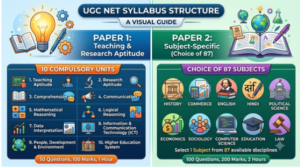
Paper 1 consists of 50 compulsory multiple-choice questions carrying 100 marks. Each question carries 2 marks, and there is no negative marking for an incorrect answer. Paper 1 and Paper 2 are conducted in the same examination session without a break, with a total duration of three hours.
The syllabus is divided into 10 units, covering areas such as Teaching Aptitude, Research Aptitude, Logical Reasoning, ICT, Data Interpretation, Environment and Higher Education System.

UGC NET Paper 1 Overview
UGC NET Paper 1 is designed to test skills that are useful for teaching, research and academic work. The questions are not limited to memorising facts. Candidates also need to understand concepts, analyse information, interpret data and apply logical thinking.
The paper is common to candidates from different subjects. Your Paper 2 subject may be History, Commerce, English, Political Science, Education or another UGC NET subject, but Paper 1 remains the same in terms of its broad syllabus.
| Particular | Details |
| Paper | Paper 1 |
| Paper Name | General Paper on Teaching & Research Aptitude |
| Subject Code | 00 |
| Nature | Common for all candidates |
| Number of Questions | 50 |
| Total Marks | 100 |
| Marks per Question | 2 |
| Question Type | Multiple-choice questions |
| Negative Marking | No |
| Duration | Part of the 3-hour UGC NET examination |
| Medium | English and Hindi, except language papers |
The examination is conducted in Computer Based Test (CBT) mode. The official NTA examination scheme states that both Paper 1 and Paper 2 contain objective-type multiple-choice questions and that there is no break between the two papers.
UGC NET Paper 1 Exam Pattern
The UGC NET examination has two papers. Paper 1 is common for everyone, while Paper 2 is based on the subject selected by the candidate.
| Paper | Questions | Marks | Main Focus |
| Paper 1 | 50 | 100 | Teaching and Research Aptitude |
| Paper 2 | 100 | 200 | Subject-specific knowledge |
| Total | 150 | 300 | Paper 1 + Paper 2 |
Paper 1 questions mainly assess teaching and research aptitude, reasoning ability, reading comprehension, divergent thinking and general awareness. Paper 2 focuses on the candidate’s chosen subject.
UGC NET Paper 1 Marking Scheme
Each question carries 2 marks. A correct answer gives 2 marks, while an incorrect answer does not result in a deduction.
- No marks are awarded for an unanswered question.
- This makes question selection important during the examination.
- Candidates should still read every question carefully because the absence of negative marking does not mean that every question can be answered correctly without proper understanding.
UGC NET Paper 1 Syllabus
The UGC NET Paper 1 syllabus contains 10 units. The official syllabus covers teaching, research, comprehension, communication, reasoning, mathematics, data interpretation, ICT, environment and higher education.
| Unit | Paper 1 Topic |
| Unit 1 | Teaching Aptitude |
| Unit 2 | Research Aptitude |
| Unit 3 | Comprehension |
| Unit 4 | Communication |
| Unit 5 | Mathematical Reasoning and Aptitude |
| Unit 6 | Logical Reasoning |
| Unit 7 | Data Interpretation |
| Unit 8 | Information and Communication Technology (ICT) |
| Unit 9 | People, Development and Environment |
| Unit 10 | Higher Education System |
The UGC’s official UGC-NET syllabus portal lists Paper 1 as General Paper on Teaching & Research Aptitude, with subject code 00. NTA’s information bulletin directs candidates to the UGC website for the NET syllabi.
Unit 1: Teaching Aptitude
Teaching Aptitude focuses on the basic ideas related to teaching and learning.
Candidates study areas such as:
- Concept and objectives of teaching
- Levels of teaching
- Characteristics of effective teaching
- Learner characteristics
- Factors affecting teaching
- Teaching methods
- Teaching support systems
- Evaluation systems
The unit requires an understanding of how teaching works and how different factors can influence the learning process.

Unit 2: Research Aptitude
Research Aptitude is an important part of Paper 1 because it introduces candidates to the basic process of academic research.
Important areas include:
- Meaning and characteristics of research
- Types and methods of research
- Steps involved in research
- Research ethics
- Thesis and article writing
- Referencing and citation
- Application of ICT in research
- Research tools and methods
Candidates should understand the difference between various research approaches instead of relying only on definitions.

Unit 3: Comprehension
This unit tests the candidate’s ability to understand written information.
A passage is provided followed by questions based on its content. Questions may test:
- Main idea
- Meaning of statements
- Conclusions
- Inferences
- Author’s argument
- Facts given in the passage
The best way to improve in this area is regular practice. Candidates should focus on understanding the passage rather than trying to answer from general knowledge.

Unit 4: Communication
Communication deals with the process of sharing information and ideas.
Important areas include:
- Meaning and types of communication
- Effective communication
- Verbal and non-verbal communication
- Barriers to communication
- Classroom communication
- Mass media and communication
Questions may require candidates to identify the appropriate communication method or understand a communication problem.

Unit 5: Mathematical Reasoning and Aptitude
This unit covers basic mathematical concepts used in reasoning and aptitude questions.
Topics include areas such as:
- Number series
- Letter series
- Coding and relationships
- Mathematical reasoning
- Fractions
- Ratios
- Percentages
- Profit and loss
- Averages
- Time and distance
The questions are generally based on concepts that can be improved through regular practice.
Unit 6: Logical Reasoning
Logical Reasoning tests the ability to understand arguments and relationships between statements.
Candidates may come across questions based on:
- Arguments
- Propositions
- Deductive reasoning
- Inductive reasoning
- Analogies
- Venn diagrams
- Fallacies
- Indian logic
- Pramanas
- Structure of arguments
This unit requires careful reading. A small change in a statement can change the answer.
Unit 7: Data Interpretation
Data Interpretation focuses on understanding and analysing information presented through data.
Questions may use:
- Tables
- Bar graphs
- Pie charts
- Line graphs
- Other graphical forms
- Quantitative and qualitative data
Candidates may need to calculate percentages, ratios, differences or trends from the given information. The key skill is not simply calculation. Candidates must first understand what the data represents and then apply the appropriate method.
Unit 8: Information and Communication Technology (ICT)
ICT covers the basic concepts and applications of technology in communication and education.
Important areas include:
- Basic ICT terminology
- Internet
- Intranet
- Audio and video conferencing
- Digital initiatives in higher education
- ICT and governance
Candidates should be familiar with commonly used digital terms and understand their basic applications.
Unit 9: People, Development and Environment
This unit connects human activities, development and environmental issues.
It includes areas such as:
- Sustainable development
- Development goals
- Human-environment interaction
- Pollution
- Climate change
- Natural resources
- Energy resources
- Natural hazards and disasters
- Environmental protection
- International environmental agreements
The unit requires a basic understanding of environmental problems and their impact on people and development.
Unit 10: Higher Education System
The final unit focuses on higher education in India.
Important areas include:
- Ancient Indian centres of higher learning
- Development of higher education after independence
- Conventional and non-conventional learning
- Professional and technical education
- Skill-based education
- Value education
- Environmental education
- Governance and administration
- Policies related to higher education
This unit is useful for understanding the structure and development of India’s higher education system.
UGC NET Paper 1 Important Topics
There is no officially declared list of questions or topics that are guaranteed to appear in the examination. However, candidates can identify important areas by studying the official syllabus and analysing previous question papers.
Some areas that deserve regular practice include:
| Unit | Areas to Practise |
| Teaching Aptitude | Teaching levels, learner characteristics, methods and evaluation |
| Research Aptitude | Research methods, steps, ethics and types of research |
| Comprehension | Passage-based questions and inference |
| Communication | Types, barriers and classroom communication |
| Mathematical Reasoning | Series, percentages, ratios and basic calculations |
| Logical Reasoning | Arguments, reasoning, Venn diagrams and fallacies |
| Data Interpretation | Tables, graphs, percentages and comparisons |
| ICT | Internet, digital tools, e-learning and ICT terminology |
| People, Development and Environment | Pollution, climate change, resources and sustainable development |
| Higher Education System | Institutions, policies, governance and development of higher education |
These areas should be treated as preparation priorities rather than guaranteed examination questions.
How to Prepare for UGC NET Paper 1
Preparing for UGC NET Paper 1 becomes easier when you follow a simple and regular study plan. Start by understanding the complete syllabus and divide the topics according to your strengths and weak areas.
Focus on these points:
- Understand the syllabus: Know all 10 units before starting your preparation.
- Study concepts first: Build a clear understanding of Teaching Aptitude, Research Aptitude, Reasoning, ICT, Data Interpretation and other topics.
- Practise PYQs: Solve previous year questions regularly to understand the type and level of questions.
- Make short notes: Keep important definitions, formulas, facts and concepts in one place for quick revision.
- Take mock tests: Practise full-length tests to improve your speed, accuracy and time management.
- Revise regularly: Keep revising old topics instead of studying new topics every day.
- Work on weak areas: Spend more time on topics where you make repeated mistakes.
The best approach is simple: Study the concept – Solve PYQs – Analyse mistakes – Revise – Take a mock test.
With regular practice and proper revision, you can prepare for UGC NET Paper 1 in a more organised way.
Conclusion
UGC NET Paper 1 is not only about memorising facts. A good preparation plan includes understanding concepts, solving previous year questions, practising mock tests and revising regularly. Start with the syllabus, identify your weak areas and give them enough practice.
With consistent preparation and proper time management, you can improve your accuracy and confidence for the exam. Keep your study material limited, revise what you have already studied and track your mistakes throughout the preparation.