


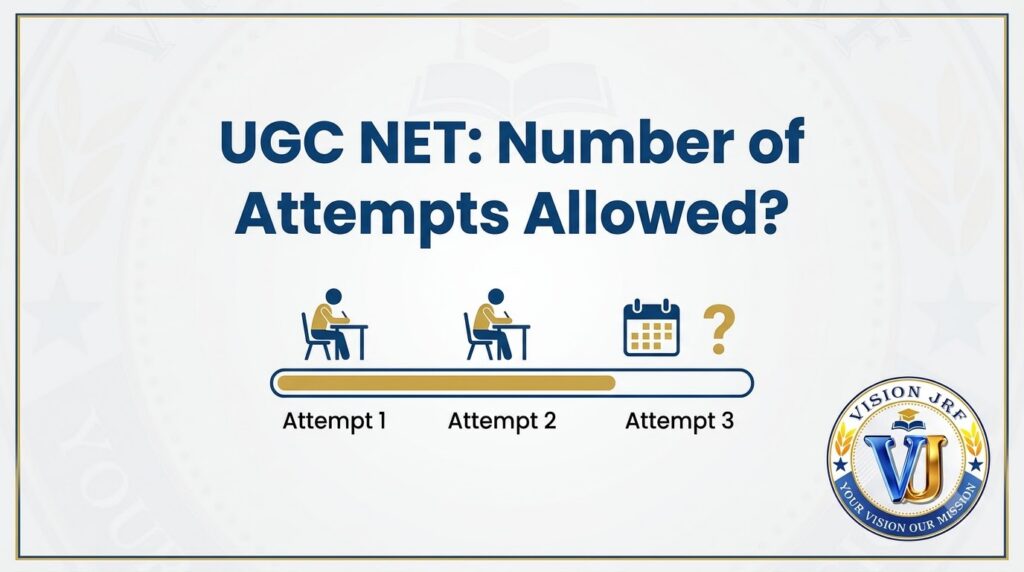

UGC NET is a national-level exam conducted by NTA for eligibility for JRF, Assistant Professor and PhD-related categories. One common question among candidates is whether there is any limit on the number of times they can appear for the exam.

UGC NET Number of Attempts Limit
Candidates can appear for UGC NET as many times as they are eligible. NTA does not prescribe a fixed number such as two, three or five attempts. So, if a candidate does not qualify in one attempt, they can apply again in a later UGC-NET cycle, subject to the eligibility rules of that cycle.
| UGC NET Rule | Details |
| Number of attempts | No fixed limit |
| JRF attempts | No fixed limit, subject to JRF age and other eligibility rules |
| Assistant Professor attempts | No fixed limit |
| PhD admission attempts | No fixed limit |
| JRF age limit | Applicable |
| Assistant Professor upper age limit | No upper age limit |
| PhD admission upper age limit | No upper age limit |
The latest NTA information bulletin does not prescribe a maximum number of attempts.

UGC NET Number of Attempts More Than Once
A candidate can appear in UGC NET more than once.
- For example, if a candidate appears in one exam cycle but does not qualify, they can apply for another cycle when applications open, provided they meet the eligibility requirements.
- There is also no rule that prevents a candidate from appearing again after already qualifying UGC NET.
However, candidates applying for JRF must continue to satisfy the JRF age requirement at the relevant age cut-off date.
UGC NET Number of Attempts JRF
there is no separate attempt limit for JRF. The restriction is based on age, not on the number of times you have appeared for the examination.
For the June 2026 cycle, the upper age limit for JRF was 30 years, with relaxation available under the prescribed rules. Therefore, a candidate can take UGC NET multiple times, but they must remain eligible for JRF when they apply for that category.
Example
- Suppose a candidate appears for UGC NET at the age of 27 but does not qualify for JRF.
- They can apply again in a later cycle if they still meet the JRF age and educational requirements.
- There is no rule saying that the candidate gets only a fixed number of JRF attempts.
UGC NET Number of Attempts Rules
The attempt rule is simple, but the age rule changes depending on the qualification category.
| Category | Attempt Limit | Upper Age Limit |
| JRF | No fixed limit | Applicable |
| Assistant Professor | No fixed limit | No upper age limit |
| PhD admission | No fixed limit | No upper age limit |
This means a candidate above the JRF age limit may still be able to appear for UGC-NET for the other applicable categories if they meet the educational requirements.
UGC NET JRF Age Limit
The JRF age limit is separate from the number of attempts. For the June 2026 examination, the upper age limit for JRF was 30 years, with applicable relaxations for specified candidates. Candidates should always check the information bulletin for the examination cycle they are applying for because the age cut-off date is linked to that particular cycle.
UGC NET JRF Age Relaxation
Eligible candidates can receive age relaxation under the UGC-NET rules.
These include specified categories such as:
- OBC-NCL
- SC
- ST
- PwD/PwBD
- Third Gender
- Women candidates
- Certain candidates with research experience
- L.L.M. candidates
- Eligible armed-forces personnel
The exact relaxation and conditions should be checked in the latest NTA information bulletin rather than assumed from an older exam cycle.
UGC NET Number of Attempts for Assistant Professor
There is no fixed number of attempts for UGC-NET when appearing for Assistant Professor eligibility.
- There is also no upper age limit for this category.
- This means a candidate can continue to appear for UGC-NET in later cycles as long as they meet the applicable educational and other eligibility conditions.
UGC NET Number of Attempts for PhD Admission
No fixed attempt limit is prescribed for UGC-NET for the PhD admission category. There is also no upper age limit for candidates applying for PhD admission through UGC-NET, subject to the rules applicable to the relevant category and admission process.
UGC NET Number of Attempts After Qualifying
Qualifying UGC NET does not mean that a candidate can never appear again.
- A candidate may choose to appear in a later cycle if they meet the eligibility conditions for that examination.
- The category for which a candidate is seeking qualification may also matter, particularly when JRF eligibility is involved.
UGC NET Number of Attempts Affect Future Attempts
Not qualifying in one UGC NET examination does not create a permanent restriction on future attempts.
- A candidate can apply again in a later cycle if they fulfil the eligibility conditions.
- There is no separate penalty for having appeared unsuccessfully in previous UGC-NET examinations.

UGC NET Exam Conducted
UGC-NET has traditionally been conducted in two cycles in a year, generally referred to as the June and December cycles.
- However, candidates should not assume that the exact examination schedule will always remain the same. NTA publishes the application notice and examination schedule for each cycle separately.
- For example, NTA conducted the UGC-NET June 2026 examination and published separate notices for its application, examination, answer key and result stages.
- Therefore, candidates should check the official UGC-NET website when the next application window opens.

UGC NET Number of Attempts Check Before Applying Again
Before filling another UGC-NET application form, check these points:
- Your educational qualification
- Your selected UGC-NET subject
- Your category
- JRF age eligibility, if applying for JRF
- Applicable age relaxation
- Latest NTA notification
- Application dates
- Examination schedule
- Current eligibility rules
The latest NTA Information Bulletin should always be treated as the final reference for that examination cycle.
Conclusion
The UGC NET number of attempts is unlimited. There is no rule that restricts candidates to a fixed number of attempts.
The main difference is between attempt limit and age limit. You can appear for UGC-NET multiple times, but JRF has an upper age requirement. Assistant Professor and PhD admission categories do not have an upper age limit.