


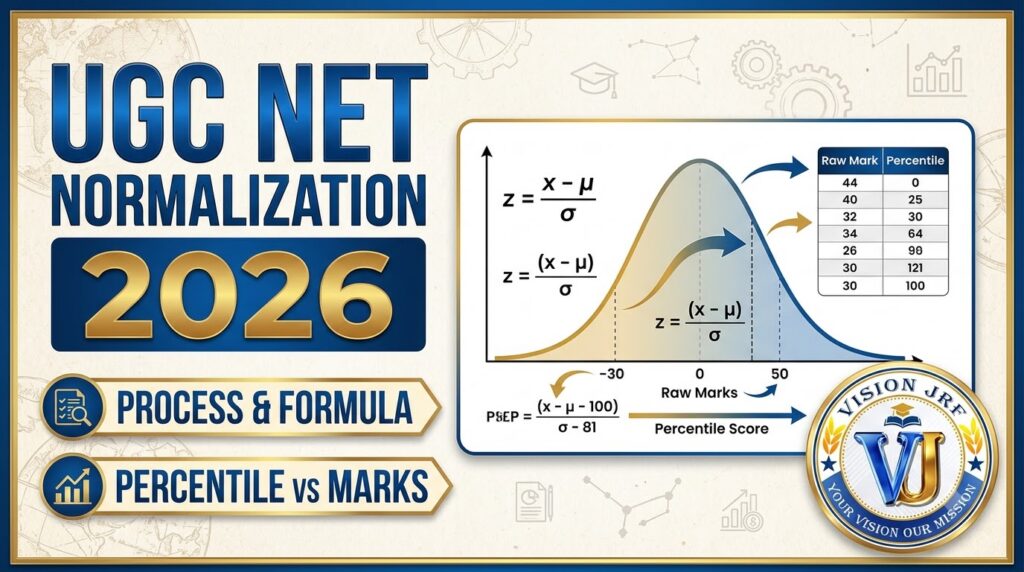

UGC NET Normalization is used when the same subject is conducted in multiple shifts. It helps NTA compare candidates fairly when different shifts have different question papers. For UGC NET June 2026, NTA planned to conduct each language, subject and General Test in a single shift. Therefore, normalisation would not normally be required. However, if any subject is held in multiple shifts due to unavoidable circumstances, NTA will apply the Equi-percentile method for normalisation. The result is declared with the candidate’s percentile along with marks or normalised marks, wherever applicable.
UGC NET Normalization 2026 Latest Update
UGC NET Normalization 2026 Latest Update explains how NTA adjusts marks when the exam is conducted in multiple shifts with different difficulty levels. The important points are:
| Particular | UGC NET Normalization 2026 |
| Conducting body | National Testing Agency (NTA) |
| When is normalisation used? | When a subject is held in multiple shifts |
| Method used | Equi-percentile method |
| Percentile calculated | Separately for each shift |
| Normalised marks | Calculated using percentile-equivalent marks across shifts |
| Result | Percentile with marks/normalised marks, where applicable |
| If the subject is held in one shift | Normalisation is not required |
What is UGC NET Normalization?
UGC NET may be conducted in multiple shifts for the same subject. Each shift has a different question paper. The difficulty level of these papers may also vary slightly. Normalization helps NTA adjust the marks to account for this difference in difficulty level.
- For example, one shift may have a slightly tougher paper while another may have a relatively easier paper.
- If candidates are compared only on their raw marks, the difference in paper difficulty may affect the comparison.
- This is where UGC NET normalization comes in.
- NTA first converts the raw performance of candidates into percentile scores. For a multi-shift subject, it then uses the Equi-percentile method to calculate normalised marks.
Why Does UGC NET Need Normalization?
UGC NET is conducted in multiple shifts, and the difficulty level of the question papers may differ. Normalization helps adjust the marks so that candidates from different shifts can be compared on a common scale. The main reason is to make scores from different shifts comparable.
Consider a simple example:
| Shift | Paper level | Candidate’s raw marks |
| Shift 1 | Relatively difficult | 180 |
| Shift 2 | Relatively easier | 190 |
Looking only at raw marks, the second candidate has more marks. But raw marks alone do not show how each candidate performed compared with others in their own shift. NTA’s percentile-based process considers the candidate’s relative position within the shift before comparing performances across shifts.
UGC NET Normalization Used in Every Exam
Normalization is relevant when the same subject is conducted in multiple shifts.
- For June 2026, NTA stated that it planned to conduct each language, subject and General Test in a single shift. If that arrangement is followed, there is no need to normalise marks.
- However, if a subject has to be conducted in multiple shifts, the Equi-percentile method will be used. So, candidates should not assume that their marks will always be normalised.
UGC NET Normalization Formula
The first important calculation is the percentile score. NTA calculates the percentile separately for each shift.
The basic formula is:
Percentile = (Number of candidates in the shift scoring equal to or below the candidate ÷ Total candidates who appeared in that shift) × 100
- For example, suppose 20,000 candidates appear in a particular shift.
- If 18,000 candidates score equal to or below a candidate’s raw marks:
Percentile = (18,000 ÷ 20,000) × 100
Percentile = 90
- This means the candidate’s raw score is at or above the performance level of the corresponding 90% of candidates in that shift.
- NTA calculates the percentile up to seven decimal places in its percentile-based normalisation procedure.
UGC NET Normalization Works
For multi-shift subjects, the June 2026 bulletin describes a three-step Equi-percentile process.
Step 1: Raw Marks Are Converted Into Percentile
- First, NTA looks at candidates within each shift separately.
- Suppose a subject is held in Shift 1 and Shift 2.
- The percentile for a candidate in Shift 1 is calculated using the performance data of candidates who appeared in Shift 1.
- The same process is followed for Shift 2.
- This gives every candidate a percentile based on their performance within their own shift.
Step 2: Percentiles Are Mapped Back to the Marks Scale
- Next, NTA compares equivalent percentile points across the different shifts.
- Suppose a particular percentile is available in both shifts. The corresponding raw marks from both shifts can then be compared.
- If an exact percentile is not available in one shift, NTA uses linear interpolation to estimate the corresponding marks at that percentile.
- This step is important because the raw marks corresponding to the same percentile may be different in different shifts.
Step 3: Normalised Marks Are Calculated
- After the percentile-equivalent marks are obtained for the different shifts, NTA calculates the normalised score for the corresponding percentile.
- For two shifts, this can be understood simply as taking the average of the equivalent marks from the two shifts.
- For more shifts, the corresponding marks from all applicable sessions are considered.

Equi-Percentile Normalization Simple Example
Suppose two shifts have different marks for the same percentile. This can happen when the difficulty level of the shifts is different.
| Shift | Marks at the Same Percentile |
| Shift 1 | 180 |
| Shift 2 | 170 |
To understand the basic idea, take the average of these marks:
(180 + 170) ÷ 2 = 175
So, in this simplified example, the normalised score for that percentile would be 175 marks.
This example only explains the basic concept. NTA’s actual normalisation process is more detailed and uses percentile matching and interpolation where required.
UGC NET Normalization 2026 Increase or Decrease Marks
It can result in a normalised mark that is higher or lower than the candidate’s raw mark.
- There is no fixed rule that normalisation will always increase marks.
- The final result depends on the relationship between the candidate’s performance and the corresponding performance levels across the different shifts.
- Therefore, candidates should not calculate an expected increase or decrease using a fixed percentage.
UGC NET Normalized Marks vs Raw Marks
Raw marks are the actual marks you get from your answers in the exam. Normalized marks are the marks adjusted by NTA to account for differences in the difficulty level of different shifts. These two terms are different.
| Raw Marks | Normalized Marks |
| Marks obtained from the candidate’s responses | Marks calculated after the multi-shift normalisation process |
| Based directly on the final answer key | Used when multi-shift normalisation applies |
| Can be calculated from correct responses | Depends on percentile comparison across shifts |
| Does not account for shift-wise comparison by itself | Accounts for equivalent performance across shifts |
For a subject conducted in one shift, there is no multi-shift normalisation requirement.

UGC NET Normalization 2026 Percentile vs Percentage
Many candidates confuse percentage and percentile, but both have different meanings.
- Percentage shows how many marks you scored out of the total marks. For example, if you score 240 out of 300 marks, your percentage is 80%.
- Percentile shows your relative position among the candidates considered for the calculation. For example, a 95 percentile does not mean that you scored 95% marks. It shows your position on the percentile scale used by NTA.
- So, percentage is based on your marks, while percentile shows your relative position among candidates.

UGC NET Normalization 2026 Final Score
UGC NET has two papers.
- Paper 1: 50 questions, 100 marks
- Paper 2: 100 questions, 200 marks
- Total: 150 questions, 300 marks
- Duration: 3 hours
- No negative marking
Each correct answer carries 2 marks. Candidates first get marks based on their responses and the final answer key. If the subject is conducted in multiple shifts, the applicable normalisation procedure is then used. So, a candidate should not try to replace the official normalised score with a self-calculated estimate.
UGC NET Normalization 2026 Apply to Paper 1, Paper 2 Separately
Candidates should understand one important point. NTA applies the normalization process to the overall marks obtained in the examination, based on the applicable normalization method. Paper 1 and Paper 2 are not treated as two separate exams for normalization.

The normalisation process is not simply:
Paper 1 percentile + Paper 2 percentile = final percentile
- NTA’s procedure works with the relevant total raw score for the session when calculating the percentile. The official procedure also states that the total percentile is not an average of individual subject percentiles.
- Therefore, candidates should not calculate their final UGC NET percentile by averaging separate Paper 1 and Paper 2 percentiles.
UGC NET Cut Off Decided After Normalization
Normalization and cut-off are related, but they are not the same thing. First, NTA processes candidate performance according to the applicable scoring and normalisation procedure.The qualifying process then considers the subject-wise and category-wise performance and the available qualifying slots.
For UGC NET, the minimum aggregate requirement is:
| Category | Minimum aggregate in both papers |
| General/Unreserved | 40% |
| General-EWS | 40% |
| OBC-NCL | 35% |
| SC | 35% |
| ST | 35% |
| PwD/PwBD | 35% |
| Third Gender | 35% |
Candidates must appear in both papers.
However, meeting the minimum percentage does not automatically mean qualification for JRF or Assistant Professor. The final subject-wise and category-wise cut-off is determined through NTA’s result methodology.
UGC NET Normalization 2026 Affect JRF and Assistant Professor Qualification
Yes, when normalisation is applicable, the processed score forms part of the result process.
UGC-NET qualification is divided into three categories:
| Category | Qualification |
| Category 1 | JRF + Assistant Professor + PhD admission |
| Category 2 | Assistant Professor + PhD admission |
| Category 3 | PhD admission only |
NTA’s June 2026 bulletin states that the result is declared in percentile along with marks or normalised marks where multiple shifts are involved.
Can Candidates Calculate Final Normalized Marks?
Candidates can calculate their raw marks from the final answer key if they know their correct and incorrect responses.
- But the final normalised score depends on shift-wise candidate data and the Equi-percentile process used by NTA.
- This information is not available to an individual candidate in the complete form required to reproduce the official calculation.
- Therefore, an online calculator may provide an estimate, but it should not be treated as the official NTA normalised score.