




UGC NET Minimum Qualifying Marks 2026 are 40% for General/General-EWS candidates and 35% for reserved categories. Since the exam is of 300 marks, this means 120 marks and 105 marks respectively. However, these are only the minimum marks, not the final cut-off for qualification.
UGC NET Minimum Qualifying Marks 2026 Overview
The minimum qualifying percentage is based on the marks obtained in both papers together.
| Category | Minimum Qualifying Percentage | Marks Out of 300 |
| General / Unreserved | 40% | 120 |
| General-EWS | 40% | 120 |
| OBC-NCL | 35% | 105 |
| SC | 35% | 105 |
| ST | 35% | 105 |
| PwD/PwBD | 35% | 105 |
| Third Gender | 35% | 105 |
UGC NET Minimum Qualifying Marks 2026 minimum marks calculated
UGC NET has two papers:
- Paper 1: 50 questions, 100 marks
- Paper 2: 100 questions, 200 marks
- Total: 150 questions, 300 marks
The minimum qualifying percentage is calculated using the total marks of both papers.
For example:
General/General-EWS:
40% of 300 = 120 marks
Reserved categories:
35% of 300 = 105 marks
A candidate does not need to score 40% or 35% separately in Paper 1 and Paper 2. The requirement is based on the aggregate marks of the two papers.

UGC NET Minimum Qualifying 2026 With 120 Marks
120 marks is the minimum qualifying threshold for General/General-EWS candidates, but it is not the final UGC NET cut-off.
The same applies to 105 marks for candidates eligible for the 35% threshold.
After the minimum qualifying condition is met, NTA applies the prescribed selection methodology and publishes cut-offs according to:
- Subject
- Category
- JRF
- Assistant Professor
- PhD admission
This is why a candidate can score above the minimum percentage but still not qualify for a particular UGC NET eligibility category.
UGC NET Minimum Qualifying 2026 Marks vs Cut Off
These two terms are often confused.
| Minimum Qualifying Marks | Final UGC NET Cut Off |
| Fixed qualifying threshold | Subject and category specific |
| 40% for General/General-EWS | Can be much higher |
| 35% for applicable reserved categories | Varies by subject and category |
| Calculated on both papers together | Released separately for JRF, Assistant Professor and PhD |
| Meeting it makes a candidate eligible for further consideration | Determines qualification for the relevant category |
For example, in the official UGC NET June 2026 cut-off list, the Unreserved category cut-off for History was 190 marks for JRF, 168 for Assistant Professor and 148 for PhD only. These figures are clearly above the 120-mark minimum qualifying threshold.
This shows why candidates should not treat the minimum qualifying marks as the final score required for qualification.
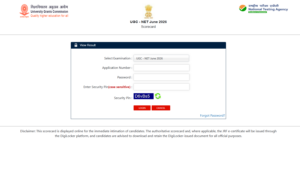
UGC NET Re Exam Result 2026 Out
The UGC NET June 2026 re-exam result for English, Commerce, and Sociology has been declared on 18 September 2026 on the official NTA website.
- The results were released separately after the September re-examination for these three subjects.
- The result determines candidates’ eligibility for Junior Research Fellowship (JRF), Assistant Professor, or PhD admission, based on their performance plus the applicable eligibility criteria.
UGC NET Re Exam Result 2026 Out: Click to Check
UGC NET Minimum Qualifying 2026 June Latest Update
NTA declared the UGC NET June 2026 result for 84 subjects on 28 August 2026. The examination for English, Commerce and Sociology was conducted separately on 9 and 10 September 2026, followed by their results and cut-offs on 17 September 2026.
The official cut-off list is available subject-wise and category-wise. It gives separate marks for:
- JRF
- Assistant Professor
- PhD only
For example, the official June 2026 cut-off for some major subjects in the Unreserved category was:
| Subject | JRF | Assistant Professor | PhD Only |
| History | 190 | 168 | 148 |
| Political Science | 222 | 196 | 170 |
| Psychology | 204 | 180 | 160 |
| Education | 232 | 206 | 182 |
| Economics | 224 | 196 | 170 |
These are official June 2026 cut-off marks, not minimum qualifying marks. The complete NTA PDF contains category-wise figures, including OBC-NCL, EWS, SC, ST and PwD categories.

UGC NET Minimum Qualifying 2026 Cut Off Change
The minimum qualifying percentage is different from the final cut-off because the final cut-off depends on the examination and the prescribed qualification methodology.
Important factors include:
- Number of candidates appearing
- Performance of candidates
- Subject-wise competition
- Category-wise allocation
- Number of qualifying slots
- Eligibility category such as JRF, Assistant Professor or PhD
Therefore, there is no single final UGC NET cut-off that applies to every subject.
UGC NET June Result 2026 Statistics
The UGC NET June 2026 exam saw 7,73,806 candidates registered across 84 subjects, while 6,07,151 candidates appeared for the examination.
As per the result statistics, 4,241 candidates qualified for JRF and Assistant Professor, while 45,904 candidates qualified for Assistant Professor and admission to Ph.D. A total of 97,434 candidates qualified for Ph.D. only.
The table below gives a clear overview of the UGC NET June 2026 result statistics:
| Particulars | Number of Candidates |
| Candidates registered (84 Subjects) | 7,73,806 |
| Candidates appeared (84 Subjects) | 6,07,151 |
| Qualified for JRF and Assistant Professor | 4,241 |
| Qualified for Assistant Professor and Admission to Ph.D. | 45,904 |
| Qualified for Ph.D. only | 97,434 |
UGC NET Minimum Qualifying 2026 for Paper 1 and Paper 2
No separate minimum percentage is prescribed for Paper 1 and Paper 2 individually for this qualifying threshold.
The marks of both papers are considered together.
For example, suppose a General category candidate scores:
- Paper 1 = 70 marks
- Paper 2 = 55 marks
Total = 125 marks
The candidate has crossed the 120-mark minimum qualifying threshold.

But crossing 120 marks alone does not confirm qualification. The candidate must still meet the applicable subject/category-wise cut-off and other conditions used for determining the result.

UGC NET Minimum Qualifying 2026 Negative Marking
No. The UGC NET examination does not have negative marking. Each correct answer carries 2 marks.
The exam consists of 150 questions for a total of 300 marks:
| Paper | Questions | Marks |
| Paper 1 | 50 | 100 |
| Paper 2 | 100 | 200 |
| Total | 150 | 300 |
The two papers are conducted as part of the same three-hour examination session.
UGC NET Minimum Qualifying Marks 2026 Targeted Score
There is no single score that can guarantee qualification because the final cut-off changes according to the subject, category and eligibility category.
- Instead of focusing only on 120 or 105 marks, candidates should check the latest official cut-off for their subject and category.
- For candidates who have already appeared in the June 2026 examination, the NTA cut-off PDF is more useful than a general “safe score” because it shows the actual marks used for JRF, Assistant Professor and PhD-only qualification.
- For candidates preparing for a future UGC NET session, the relevant NTA Information Bulletin should be checked when released because the official notification is the final source for that session.
UGC Net Exam June 2025 Subject Category Wise Cutoff Marks pdf
UGC NET Minimum Qualifying Marks 2026 Important Points
Keep these points in mind:
- General and Unreserved candidates need 40% aggregate marks.
- General-EWS candidates also fall under the 40% minimum aggregate requirement for the June 2026 rules.
- OBC-NCL, SC, ST, PwD/PwBD and Third Gender candidates have a 35% aggregate threshold under the June 2026 rules.
- The marks are calculated from Paper 1 and Paper 2 together.
- 40% of 300 marks is 120 marks.
- 35% of 300 marks is 105 marks.
- These are minimum qualifying marks, not final cut-off marks.
- NTA releases cut-offs separately by subject, category and eligibility category.
- JRF, Assistant Professor and PhD-only cut-offs can be different.
- Candidates should always check the latest NTA cut-off PDF for their subject.
Conclusion
The UGC NET Minimum Qualifying Marks 2026 are 120 marks for General/General-EWS candidates and 105 marks for the applicable reserved categories, based on the combined marks of Paper 1 and Paper 2. But these marks should not be confused with the final UGC NET cut-off. The final cut-off is released separately for different subjects, categories and eligibility categories such as JRF, Assistant Professor and PhD only. For the latest result, candidates should use the official NTA cut-off rather than relying on a fixed expected score.