




UGC NET merit list is prepared through the result and cut-off process used by the National Testing Agency (NTA). For June 2026, NTA declared the result for 84 subjects on 28 August 2026 and later declared the result for English, Commerce and Sociology after their re-examination on 17 September 2026.
NTA does not treat the UGC NET merit list like a simple overall rank list. Qualification is decided using candidates’ performance in both papers, minimum qualifying marks, category-wise reservation and subject-wise cut-off requirements. For multi-shift papers, NTA also uses the prescribed normalisation process.
Candidates can check their UGC NET result and scorecard through the official UGC-NET website.
UGC NET Merit List 2026 Latest Update
For June 2026, NTA’s result was released in two stages.
| UGC NET June 2026 update | Date | Status |
| Result for 84 subjects | 28 August 2026 | Released |
| English, Commerce and Sociology re-examination | 9–10 September 2026 | Completed |
| Result for 3 re-exam subjects | 17 September 2026 | Released |
| Category-wise cut-off | Released | Available |
The first result covered 84 subjects. English, Commerce and Sociology were held again in September, so their result was released separately.
For this reason, candidates searching for the UGC NET merit list 2026 should check the latest result and cut-off notices rather than relying on an old merit-list PDF.
What Is UGC NET Merit List?
In simple terms, the UGC NET merit process identifies candidates who meet the required conditions for different eligibility categories.
The result process considers:
- Performance in Paper 1 and Paper 2
- Minimum aggregate qualifying marks
- Subject
- Category
- Available eligibility slots
- Reservation rules
- Normalised scores where applicable
- Category-wise and subject-wise cut-offs
The June 2026 Information Bulletin states that the number of candidates eligible for Assistant Professor is based on 6% of candidates who appear in both papers, followed by category-wise allocation according to the reservation policy.
So, the UGC NET merit process is more than simply arranging all candidates from highest marks to lowest marks.

How Is UGC NET Merit Decided?
NTA follows a defined process to evaluate candidates’ performance, determine their qualifying status, prepare the merit list, and declare the final result.
Step 1: Minimum qualifying requirement
A candidate must appear in both papers and secure at least:
| Category | Minimum aggregate marks |
| General / Unreserved | 40% |
| General-EWS | 40% |
| OBC-NCL | 35% |
| SC | 35% |
| ST | 35% |
| PwD/PwBD | 35% |
| Third Gender | 35% |
These are the basic qualifying requirements. Meeting them alone does not guarantee JRF or Assistant Professor qualification.
Step 2: Assistant Professor slots
Under the June 2026 rules, the number of candidates to be qualified for Assistant Professor eligibility is calculated as 6% of candidates who appeared in both papers.
These slots are then distributed among categories according to the applicable reservation policy.
Step 3: Subject-wise and category-wise calculation
The available slots are distributed across subjects and categories using the prescribed methodology.
This produces separate qualifying cut-offs for different combinations of:
Subject + Category + Eligibility category
Therefore, there is no single UGC NET merit cut-off applicable to every candidate.
Step 4: JRF allocation
JRF slots are allocated separately among categories according to the applicable rules.
This is why a candidate may qualify for Assistant Professor eligibility but not receive JRF.
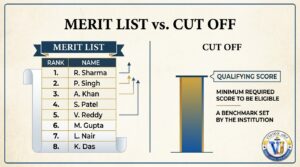
UGC NET Merit List vs UGC NET Cut Off
These two terms are often used together, but they are not the same.
| UGC NET Merit Process | UGC NET Cut Off |
| Used to determine qualification | Shows the qualifying marks for a particular subject/category |
| Considers candidate performance and available slots | Published subject-wise and category-wise |
| Includes eligibility categories | Separate cut-offs can be given for JRF, Assistant Professor and PhD |
| Part of result preparation | Released with or around the result |
For June 2026, NTA published a category-wise cut-off document for the 84 subjects and another cut-off document for the three re-exam subjects.
UGC NET Merit List 2026 Result
NTA’s first June 2026 result notice gave the following figures for 84 subjects:
| Result category | Candidates qualified |
| JRF and Assistant Professor | 4,241 |
| Assistant Professor and PhD admission | 45,904 |
| PhD only | 97,434 |
A total of 6,07,151 candidates appeared in these 84 subjects. For the three subjects held again in September, NTA reported:
| Result category | Candidates qualified |
| JRF | 824 |
| Assistant Professor | 11,610 |
| PhD only | 23,154 |
The three-subject re-examination had 1,20,355 candidates appearing.
UGC NET Merit List for JRF
JRF is a separate eligibility category within UGC NET. The June 2026 rules provide for allocation of JRF slots among categories. Candidates must meet the applicable eligibility conditions along with the performance requirements of the examination.
- The JRF qualifying cut-off can therefore be different from the Assistant Professor cut-off for the same subject and category.
- For example, the June 2026 cut-off document gives separate JRF and Assistant Professor cut-offs for each subject/category combination.
UGC NET Merit List for Assistant Professor
Candidates who qualify under the Assistant Professor category can use their UGC NET qualification when applying for eligible teaching positions. However, qualifying UGC NET does not mean that NTA directly provides an Assistant Professor job. Recruitment is carried out by the concerned university, college or institution according to its rules.
The UGC-NET result categories distinguish between:
- JRF + Assistant Professor
- Assistant Professor + PhD admission
- PhD only
The official UGC-NET information explains these three categories and the eligibility attached to each one.
UGC NET Merit List for PhD Admission
The UGC-NET result also includes a PhD-only category.
- For candidates qualifying under Category 2 and Category 3, the June 2026 rules state that NET marks carry 70% weightage, while the university or higher education institution interview/viva carries 30% weightage for PhD admission.
- Therefore, the UGC NET result is not the complete PhD admission decision for these categories.
The concerned university or institution conducts the remaining admission process.
How to Check UGC NET Merit List or Result?
Candidates should check the official result rather than depending on unofficial merit-list websites.
Follow these steps:
- Visit the official UGC-NET website.
- Open the latest result or scorecard link.
- Enter your Application Number.
- Enter the required login details.
- Submit the information.
- Check your scorecard.
- Download and save it for future use.
NTA’s June 2026 result notice confirms that candidates can log in to the official website to view, download and print their scorecard.
Is There a Separate UGC NET Merit List PDF?
Candidates should be careful with this question. NTA’s current UGC-NET result documents publish the result, scorecard and subject/category-wise cut-off information. The official June 2026 notices do not present a single all-India rank-wise merit list containing every candidate.
This means students should not assume that a PDF circulating online as the “UGC NET Merit List 2026” is an official NTA merit list.
For the official status, check:
- UGC-NET scorecard
- Subject-wise cut-off
- Category-wise cut-off
- Qualification category
- NTA public notices
The official UGC-NET document section currently lists the June 2026 result and cut-off notices.
UGC NET Merit List vs Normalisation
UGC NET may be conducted in multiple shifts.
- When a subject is held in multiple shifts, NTA uses the prescribed normalisation method to calculate NTA scores/percentiles.
- The June 2026 Information Bulletin states that the normalised scores are merged for further processing.
- This means candidates should not compare raw marks from different shifts without considering the applicable normalisation process.
- The score shown by NTA should be used when checking the result and qualification.
What Is Difference Between Merit and Cut Off?
A simple way to understand it is:
- Merit process = How qualification is determined
- Cut off = The marks at which qualification is reached for a particular subject/category
- For example, a candidate may score above the basic 40% or 35% qualifying requirement but still not qualify for a particular eligibility category if the applicable subject/category cut-off is higher.
- This is why checking only the minimum qualifying marks is not enough.
What After UGC NET Merit Result?
The next step depends on the qualification category shown in the result.
JRF-qualified candidates
Candidates qualifying for JRF can use their eligibility for research opportunities and fellowship-related benefits according to the applicable UGC rules.
Assistant Professor-qualified candidates
Candidates can use their UGC NET qualification when applying for eligible Assistant Professor recruitment. The actual appointment depends on the recruitment process of the concerned institution.
PhD-qualified candidates
Candidates qualifying for PhD admission should check the admission notification of the university or higher education institution where they want to apply.
For Category 2 and Category 3 candidates, the June 2026 rules provide for the NET score and university interview/viva to contribute to the PhD admission process.
UGC NET Merit List Important Points
Keep these points in mind:
- UGC NET does not work on one common cut-off for every candidate.
- Subject and category both matter.
- The minimum qualifying marks are different from the final cut-off.
- JRF and Assistant Professor have separate eligibility considerations.
- PhD-only qualification is a separate category.
- Normalisation may apply where a subject is conducted in multiple shifts.
- The official scorecard is more important than an unofficial merit-list PDF.
- NTA’s official cut-off notice should be used for checking the qualifying marks.
Conclusion
The UGC NET merit list is best understood as part of the overall result and qualification process rather than as a single nationwide rank list. NTA uses candidate performance, minimum qualifying requirements, reservation rules, subject-wise calculations and applicable normalisation to decide eligibility.
For June 2026, NTA has already released the result and category-wise cut-offs. Candidates should use their official scorecard and the NTA cut-off notice to understand their qualification status. Future UGC NET sessions should be checked against the latest NTA notification because the result schedule and official documents may change.