




Many students think UGC NET comes with a monthly salary. It does not. NET only makes you eligible. What you earn depends on the path you choose next. Clear it with JRF and you get a fellowship while you do your PhD. Clear it for Assistant Professor and you can apply for teaching jobs. The salary starts only after a college or university hires you.

UGC NET JRF Salary overview
Before looking at the detailed fellowship, salary structure, HRA and career growth, let us first understand the UGC NET Salary overview and what you can expect after qualifying for NET.
| Path after UGC NET | What you get |
| NET with JRF (first 2 years) | ₹37,000 per month |
| SRF (after 2 years) | ₹42,000 per month |
| Assistant Professor | Basic pay from ₹57,700 (Level 10) |
| NET without JRF | No automatic payment |
The Assistant Professor figure is basic pay. It is not what reaches your bank account.
UGC NET As a Job
UGC NET is not a job. It is an eligibility examination conducted by the National Testing Agency (NTA) on behalf of the UGC. Clearing the exam does not mean that you are directly appointed as a teacher, professor or researcher.
After qualifying UGC NET, a candidate can fall into one of three categories:
- JRF and Assistant Professor
- Assistant Professor only
- PhD admission only
These categories are important because the benefit you receive depends on the category in which you qualify.
For example- a candidate who qualifies for JRF and Assistant Professor can be eligible for the JRF fellowship, subject to the applicable conditions. A candidate who qualifies for Assistant Professor only does not receive the JRF fellowship simply because they cleared NET. A candidate qualifying for the PhD admission category can use the qualification for PhD admission as per the applicable university or institution rules.
- This is why the term UGC NET salary can sometimes be confusing. UGC NET itself does not give you a fixed monthly salary.
- The money a candidate may receive after qualifying depends on what they do next.
There are mainly two different things about UGC NET salary:
- JRF Fellowship: A candidate who qualifies for JRF and joins eligible research can receive a monthly fellowship during the research period.
- Assistant Professor Salary: A candidate who qualifies for Assistant Professor can apply for teaching positions. If selected by a college or university, they receive a salary according to the applicable post, institution and employment rules.
So, qualifying UGC NET and getting a job are two different steps. UGC NET provides eligibility for certain academic opportunities. A teaching position still requires the candidate to apply for a suitable post and get selected.
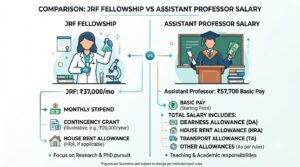
UGC NET JRF Salary
If you qualify for JRF and then join a PhD at a recognised university or institute, you receive a monthly fellowship during your eligible research period.
| Period | Fellowship |
| First 2 years — JRF | ₹37,000 per month |
| Remaining years — SRF | ₹42,000 per month |
The fellowship can continue for up to five years. The first two years are counted as the JRF period. After that, the candidate can move to the Senior Research Fellowship (SRF) stage for the remaining three years, subject to the required research progress.
This means the fellowship structure is:
Year 1 – ₹37,000 per month
Year 2 – ₹37,000 per month
Year 3 – ₹42,000 per month
Year 4 – ₹42,000 per month
Year 5 – ₹42,000 per month
The fellowship can end before five years if the candidate submits the thesis earlier. Before moving from JRF to SRF, the candidate’s research progress is checked.
UGC NET Salary JRF HRA, Contingency Grant
Apart from the monthly JRF fellowship, a research scholar can receive some additional support for accommodation plus research-related expenses.
HRA
HRA stands for House Rent Allowance. If you do not stay in the institute hostel, you can receive HRA according to the applicable norms.
So, HRA is linked to accommodation. It is separate from the basic monthly fellowship.
Contingency Grant
A contingency grant is provided for certain research-related expenses. It can help with costs such as:
- Books
- Fieldwork
- Printing
- Other eligible research expenses
The amount mentioned in your content differs according to the subject area:
| Subject Area | During JRF | During SRF |
| Humanities and Social Sciences | ₹10,000 per year | ₹20,500 per year |
| Science | ₹12,000 per year | ₹25,000 per year |
- The important point is that these amounts are yearly contingency grants, not monthly payments.
- For example, if a candidate receives ₹37,000 per month during JRF plus a ₹10,000 yearly contingency grant, the ₹10,000 should not be added to the monthly amount to claim a higher monthly salary.
- JRF fellowship, HRA and contingency grant are different components. The contingency grant is meant to support eligible research expenses, so it should not be presented as part of the monthly salary.

UGC NET Assistant Professor Salary
Here is where most students get confused. Clearing NET for Assistant Professor does not mean ₹57,700 starts next month. You still have to apply for a vacancy, clear the selection and get appointed.
- It works like a driving licence. The licence lets you drive, but it does not give you a car or a driver’s job.
- Where the UGC pay structure applies, an entry-level Assistant Professor sits at Academic Level 10. The pay range is ₹57,700 to ₹1,82,400. You start at ₹57,700 and move up through increments and promotions.
UGC NET JRF Salary Basic Pay, Gross Salary, In-Hand Salary
These three are not the same:
- Basic pay: The amount fixed for your pay level. At Level 10, it starts at ₹57,700.
- Gross salary: Basic pay plus allowances like DA, HRA and TA.
- In-hand salary: What you get in your bank account after deductions.
No single in-hand figure fits every Assistant Professor. Two teachers with the same basic pay can take home different amounts if one works in a metro city and the other in a small town. If a website gives you one fixed in-hand salary, be careful with it.
UGC NET Career Growth
If you qualify for Assistant Professor, your academic career can progress through different levels.under which an Assistant Professor can move to higher positions after meeting the required conditions related to experience, qualifications and performance.
The basic career path is:
Assistant Professor – Associate Professor – Professor – Head of Department or Dean
This means an Assistant Professor can gradually take on higher academic responsibilities as they gain experience and meet the required conditions.

JRF Career Path
A JRF holder generally follows a research-focused path in the beginning:
JRF – SRF – PhD – Research Associate or Assistant Professor
- The JRF stage provides fellowship support during research. After completing the required JRF period, the candidate can move to the SRF stage, subject to the applicable conditions.
- Many JRF holders then complete their PhD. After completing the PhD, they may apply for Assistant Professor positions or continue towards research-based careers.
- Not every JRF holder follows exactly the same path. Some candidates move into research roles in institutes or government bodies, while others choose an academic teaching career.So, in simple terms, UGC NET can lead towards two broad career directions: teaching or research.
JRF vs Assistant Professor
| Point | JRF | Assistant Professor |
| Type | Research fellowship | Job |
| Starting amount | ₹37,000 per month | Basic pay from ₹57,700 |
| Later stage | ₹42,000 as SRF | Higher pay through increments and promotions |
| Comes automatically after NET? | No, you need a PhD seat | No, you need to be selected |
| Extra benefits | HRA (if no hostel) and contingency grant | DA, HRA, TA and other allowances |
| Main work | Research and PhD | Teaching and academic duties |
This is not who earns more table. One pays you to study, and the other pays you to work.
Does UGC NET Guarantee a Job?
No. Qualifying UGC NET does not mean that you automatically get an Assistant Professor job.
The NTA states that Assistant Professor recruitment is carried out according to the rules of the university, college or state government that is hiring. So, after qualifying NET, you still need to go through the recruitment process for available teaching posts.
The basic path for Assistant Professor is:
NET – Apply for vacancies – Selection – Appointment – Salary
This means NET gives you the required eligibility, but you still need to find a suitable vacancy, apply for it, get selected and receive an appointment.
For JRF, the process is different:
NET with JRF – PhD seat – Fellowship under UGC rules
Here, qualifying with JRF can make you eligible for the fellowship, but you still need to secure a suitable PhD seat and complete the required process.
NET is the normal route for Assistant Professor eligibility, but the content also points out that some PhD holders may receive an exemption under UGC rules. Because the exact exemption can depend on the applicable recruitment rule, candidates should check the job notification before applying.
UGC NET JRF Salary After PhD
Completing a PhD can open more career opportunities, but it does not mean that every PhD holder receives the same salary.
Your salary can depend on factors such as:
- The position you are appointed to
- The institution where you work
- The applicable recruitment rules
- The conditions attached to the post
Career growth can also lead to changes in pay, but promotions are not automatic. You still need to meet the required conditions for promotion.
So, the main point is simple: UGC NET can provide eligibility for academic opportunities, while the actual job, appointment, salary and career progression depend on the relevant recruitment process and rules.
Is the Salary Same in Every University?
No. Each university, college or state government has its own rules. Before you apply, check these in the job advertisement:
- Basic pay and pay level
- Allowances
- Probation period
- Type of employment
- Promotion rules
- Deductions
A central university that follows the UGC scale can offer a very different package from an institution with other service rules.
Other Options After UGC NET
Many NET-qualified candidates also go for a PhD with the JRF, apply for research jobs, try public sector companies in HR, finance and research, or work as subject experts and authors.
UGC NET JRF June 2026 Result Latest Update
The NTA declared the June result on 28 August for 84 of the 87 subjects. In these subjects, 6,07,151 candidates appeared and 1,47,579 qualified.
English, Commerce and Sociology were held back. An expert committee found factual, spelling and translation mistakes in the papers, so the NTA held them again on 9 and 10 September . The re-exam result came out on 17 September .
| Re-exam detail | Number |
| Registered | 1,96,491 |
| Appeared | 1,20,355 |
| Qualified for JRF | 824 |
| Qualified for Assistant Professor | 11,610 |
| Qualified for PhD only | 23,154 |
Don’t add these to the main result figure, because they are separate. Check your category on your scorecard at ugcnet.nta.nic.in.
Final Word
If you clear JRF, you get ₹37,000 per month for two years and ₹42,000 after that, plus HRA and a contingency grant. If you clear for Assistant Professor, you earn nothing until you are hired, and then your pay starts at Level 10 from ₹57,700. So decide your path first. Research and a PhD lead to the fellowship, and a teaching job leads to the salary.