


The UGC NET JRF Eligibility rules cover the educational qualification, minimum marks, age limit and other conditions required for the Junior Research Fellowship. For the June 2026 cycle, candidates can qualify for JRF through the prescribed Master’s degree route or, under specific conditions, through a four-year bachelor’s degree.
Meeting the minimum qualification does not automatically guarantee JRF. Candidates also need to qualify UGC-NET and fulfil the applicable subject-wise and category-wise criteria.

What Is JRF?
JRF stands for Junior Research Fellowship. It is a research fellowship linked to UGC-NET qualification. A candidate who qualifies in the JRF category can pursue research, subject to the admission and fellowship rules of the concerned university or institution.
JRF and PhD are not the same. JRF provides fellowship support, while PhD is the doctoral degree for which a candidate undertakes research.
UGC NET JRF Eligibility Glance
Before moving ahead, let’s quickly look at the key UGC NET JRF eligibility criteria at a glance.
| Eligibility condition | Requirement |
| Examination | UGC-NET |
| Main qualification | Master’s degree or equivalent |
| Marks for General/Unreserved and General-EWS | 55% |
| Marks for OBC-NCL, SC, ST, PwD/PwBD and Third Gender | 50% |
| Four-year bachelor’s route | 75% marks in aggregate |
| Relaxation in four-year degree route | 5% for eligible categories |
| JRF age limit | Not more than 30 years as on 1 June |
| Age relaxation | Up to 5 years for specified categories and conditions |
| Assistant Professor age limit | No upper age limit |
| PhD admission age limit | No upper age limit |
These requirements are based on the June eligibility rules. NTA publishes the relevant examination notices, results and other information for each UGC-NET cycle on its official website.
UGC NET JRF Eligibility Educational Qualification
The usual qualification route is a Master’s degree or an equivalent qualification from a recognised university or institution.
- Candidates in the General/Unreserved and General-EWS categories need at least 55% marks in the Master’s degree.
- Candidates belonging to OBC-NCL, SC, ST, PwD/PwBD and Third Gender categories need at least 50% marks.
| Category | Minimum marks in Master’s degree |
| General/Unreserved | 55% |
| General-EWS | 55% |
| OBC-NCL | 50% |
| SC | 50% |
| ST | 50% |
| PwD/PwBD | 50% |
| Third Gender | 50% |
The marks requirement is based on the applicable UGC-NET rules. Candidates whose qualification uses a grading system should follow the prescribed equivalence or conversion rules instead of calculating a percentage on their own.
UGC NET JRF Eligibility Final-Year Master’s Students
Candidates who are pursuing their Master’s degree or waiting for their final result may apply provisionally, subject to the eligibility conditions mentioned in the latest UGC-NET information bulletin.
- However, qualifying for UGC-NET does not replace the requirement to complete the qualifying degree with the prescribed marks. Candidates must meet all eligibility conditions within the applicable time limit.
- Therefore, final-year students should always check the latest UGC-NET information bulletin before applying, as eligibility rules and timelines may change.
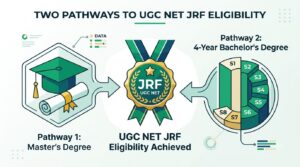
UGC NET JRF Eligibility Four-Year Bachelor’s Degree
A four-year or eight-semester bachelor’s degree provides another route for candidates who want to qualify for JRF and PhD admission.
- Candidates using this route need at least 75% marks in aggregate, or the equivalent grade where a grading system is followed. A relaxation of 5% marks or the equivalent grade is available to the categories specified in the rules.
- There is one important restriction. Candidates who qualify UGC-NET on the basis of a four-year bachelor’s degree can be considered for JRF and PhD admission, but they are not eligible for appointment as Assistant Professor through this route.
- Candidates who are still in the last semester or year of their four-year bachelor’s programme may also apply provisionally. They must fulfil the prescribed degree requirements within the applicable period after the NET result.
UGC NET JRF Eligibility Age Limit
The UGC NET JRF Eligibility rules have a separate age condition for candidates seeking the fellowship.
For the June examination, a candidate must not be more than 30 years of age as on 1 June. The bulletin provides age relaxation for specified categories and other eligible conditions.
| Category or condition | Age relaxation |
| OBC-NCL, SC, ST, PwD/PwBD, Third Gender and women candidates | Up to 5 years |
| Relevant research experience | Period of eligible research, up to 5 years |
| LLM degree | 3 years |
| Armed forces service | Up to 5 years, subject to applicable conditions |
| Maximum total relaxation | Not more than 5 years |
The total relaxation cannot exceed five years. Research work completed as part of a bachelor’s or Master’s degree is not counted as eligible research experience for this purpose. Candidates claiming research-based relaxation must also provide the required certificate from the appropriate recognised authority.

UGC NET JRF Eligibility Assistant Professor or PhD
No upper age limit applies to UGC-NET eligibility for Assistant Professor or PhD admission.
- The 30-year limit is specifically related to the award of JRF.
- This distinction is important for older candidates.
- A candidate who does not meet the JRF age requirement may still be able to appear for UGC-NET for the other applicable categories, provided the educational and other conditions are fulfilled.
UGC NET JRF Eligibility Master’s Degree vs Four-Year Degree
The eligibility route depends on the degree you hold. The table below explains the key difference between a Master’s degree and a four-year bachelor’s degree for UGC NET JRF eligibility.
| Point | Master’s degree route | Four-year bachelor’s route |
| Minimum marks | 55% for General/EWS; 50% for specified categories | 75% aggregate; 5% relaxation for eligible categories |
| JRF | Yes, subject to qualifying criteria | Yes, subject to qualifying criteria |
| PhD admission | Yes, subject to applicable rules | Yes, subject to applicable rules |
| Assistant Professor | Can be applicable as per the qualification category | Not through this four-year degree route |
| Final-year candidates | Can apply provisionally under applicable rules | Can apply provisionally under applicable rules |
The four-year degree route is different from the traditional Master’s degree route. Candidates should enter their qualification details carefully while filling the application form.
Who Is Not Eligible for JRF?
A candidate may not meet the UGC NET JRF Eligibility requirements if the prescribed educational qualification, marks or age condition is not fulfilled.
Common situations include:
- The candidate has less than the required marks in the qualifying degree.
- The candidate exceeds the prescribed JRF age limit and does not have an applicable relaxation.
- A four-year bachelor’s degree candidate does not meet the required aggregate marks.
- The candidate fails to complete a provisional qualifying degree within the prescribed period.
- The candidate provides incorrect or unverifiable eligibility information.
NTA treats candidature as provisional at the application stage. If ineligibility is detected later, the candidature can be cancelled.
UGC NET JRF Eligibility PhD Admission
Qualifying for JRF does not by itself provide admission to a PhD programme.
JRF-qualified candidates can pursue research subject to the admission process of the university, institution or other eligible organisation.
- UGC states that registration for M.Phil./PhD is made by the concerned university, institution or college within the stipulated period.
- Similarly, qualifying JRF does not mean that fellowship payment starts without joining an eligible research programme.
- The fellowship remains subject to the applicable UGC rules and admission or placement requirements.
What Happens After UGC NET JRF Eligibility?
Meeting the UGC NET JRF Eligibility conditions only makes a candidate eligible to compete for JRF. The candidate still needs to complete the examination and selection process.
The basic process is:
- Submit the UGC-NET application correctly.
- Appear in both papers of the examination.
- Meet the applicable qualifying and JRF selection criteria.
- Check the result and JRF status after the examination.
- Download the JRF Award Letter if qualified.
- Complete the required PhD admission or research joining process.
The JRF offer has a validity period of three years from the date of issue of the JRF Award Letter, subject to the applicable rules.

UGC NET JRF Eligibility Key Points to Remember
For quick revision, remember these points:
- A Master’s degree is the main qualification route.
- General/Unreserved and General-EWS candidates need 55% marks.
- OBC-NCL, SC, ST, PwD/PwBD and Third Gender candidates need 50% marks.
- A four-year bachelor’s degree can also lead to JRF and PhD admission under the prescribed conditions.
- The four-year degree route requires 75% marks, with a 5% relaxation for eligible categories.
- The JRF age limit for June is 30 years as on 1 June.
- Specified categories and conditions can provide age relaxation, subject to the maximum limit.
- There is no upper age limit for Assistant Professor or PhD admission.
- Final-year candidates can apply provisionally under the applicable rules.
- Meeting eligibility requirements does not automatically mean that a candidate will receive JRF.
Candidates should check the latest NTA information bulletin before applying because eligibility conditions may change between examination cycles.