




The UGC NET exam is conducted by the National Testing Agency (NTA) to determine the eligibility of candidates for Assistant Professor and Junior Research Fellowship (JRF) in Indian universities and colleges. The exam is held in Computer-Based Test (CBT) mode and consists of Paper 1 and Paper 2. Before applying, candidates should check the latest eligibility rules, exam pattern and qualifying requirements.
UGC NET Expected Cut Off 2026
Before the UGC NET June 2026 result, some education platforms published expected cut-off ranges based on previous-year cut-offs, exam difficulty and candidate performance. One such estimate placed the expected range for the General category at around 210–216 marks, with lower ranges estimated for some reserved categories.
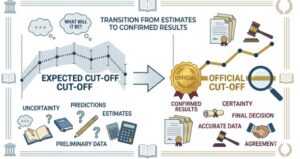
These figures were only expected cut-offs and were not released by the National Testing Agency (NTA). Since the official UGC NET June 2026 cut-off has now been released, candidates should use the official cut-off for checking their qualification instead of relying on these earlier estimates.
Expected Cut Off vs Official Cut Off
| Type | Status | How it is used |
| Expected Cut Off | Estimated | Used before the official result |
| Official Cut Off | Confirmed by NTA | Used to check actual qualification |
| Minimum Qualifying Marks | Fixed minimum requirement | 40% for General/General-EWS and 35% for applicable reserved categories |
The minimum qualifying marks and the final cut-off are also different. A candidate can cross the minimum qualifying percentage but still fall below the subject-wise cut-off.
UGC NET June 2026 Official Cut Off
The National Testing Agency (NTA) has released the subject-wise and category-wise cut-off marks for UGC NET June 2026. The cut-off marks are calculated out of the total 300 marks, combining Paper 1 and Paper 2.

The cut-off is different for each subject and category. For the Unreserved category, some of the major subject-wise cut-offs are given below:
| Subject | JRF | Assistant Professor | PhD Only |
| Economics | 224 | 196 | 170 |
| Political Science | 222 | 196 | 170 |
| Philosophy | 236 | 208 | 178 |
| Psychology | 204 | 180 | 160 |
| History | 190 | 168 | 148 |
| Education | 232 | 206 | 182 |
| Social Work | 216 | 190 | 166 |
| Management | 214 | 184 | 162 |
| Hindi | 198 | 174 | 150 |
| Geography | 250 | 220 | 188 |
| Computer Science and Applications | 214 | 180 | 158 |
These are official June 2026 figures, not expected cut-offs. NTA’s official release covers all applicable subjects and categories.
UGC NET Expected Cut Off 2026 for General Category
Before the result, expected cut-off ranges were generally prepared by looking at previous cut-offs and the perceived difficulty of the examination.
For example, one pre-result estimate gave the following overall expected range:
| Category | Expected Range Out of 300 |
| General / Unreserved | 210–216 |
| EWS | 195–205 |
| OBC-NCL | 185–200 |
| SC | 175–190 |
| ST | 165–180 |
| PwD | 160–175 |
These numbers were unofficial estimates and should not be presented as the actual June 2026 cut-off. The actual NTA cut-off varies significantly by subject. For example, the June 2026 Unreserved JRF cut-off was 190 in History but 250 in Geography.
UGC NET Expected Cut Off 2026 for JRF and Assistant Professor
The cut-off is not the same for every qualification category.
NTA’s June 2026 data provides separate marks for:
- JRF
- Assistant Professor
- PhD Only
For example, in History for the Unreserved category:
| Qualification | June 2026 Cut Off |
| JRF | 190 |
| Assistant Professor | 168 |
| PhD Only | 148 |
For Political Science, the corresponding figures were 222, 196 and 170.
This difference is important when checking your result. A score that meets the PhD-only cut-off may not meet the JRF cut-off for the same subject and category.
UGC NET Expected Cut Off 2026 Category-Wise Cut Off
The cut-off also changes according to the candidate’s category.
For example, the June 2026 History cut-off was:
| Category | JRF | Assistant Professor | PhD Only |
| Unreserved | 190 | 168 | 148 |
| EWS | 182 | 154 | 136 |
| OBC-NCL | 182 | 154 | 136 |
| SC | 168 | 144 | 130 |
| ST | 164 | 140 | 126 |
These figures demonstrate why candidates should check the cut-off for their own subject and category instead of using a single expected score.
UGC NET Expected Cut Off 2026 Decided
NTA does not publish one common cut-off for all UGC NET subjects.
The final cut-off can differ because of factors such as:
- Candidate performance
- Number of candidates appearing
- Subject-wise competition
- Category
- Number of available qualifying slots
- Eligibility category
- Overall examination conditions
Previous-year cut-offs can help candidates understand the trend, but they cannot give the exact cut-off for a new examination.
UGC NET Expected Cut Off 2026 Minimum Qualifying Marks
The minimum qualifying requirement is different from the final cut-off.
| Category | Minimum Aggregate | Marks Out of 300 |
| General / Unreserved | 40% | 120 |
| General-EWS | 40% | 120 |
| OBC-NCL | 35% | 105 |
| SC | 35% | 105 |
| ST | 35% | 105 |
| PwD/PwBD | 35% | 105 |
| Third Gender | 35% | 105 |
The marks are calculated using the combined score of Paper 1 and Paper 2.
Therefore, 120 or 105 marks should not be treated as the final UGC NET cut-off.
How to Calculate Your UGC NET Score?
The UGC NET exam is conducted for a total of 300 marks:
- Paper 1: 100 marks
- Paper 2: 200 marks
- Total: 300 marks

Each correct answer carries 2 marks, and there is no negative marking.
For example, if a candidate scores 72 marks in Paper 1 and 116 marks in Paper 2, the total score will be:
72 + 116 = 188 marks
The candidate can then compare the 188 marks with the applicable cut-off for their subject, category and eligibility category..
UGC NET Expected Cut Off 2026 Same for Every Subject
The UGC NET cut-off varies significantly across subjects. For example, in June 2026, the Unreserved category JRF cut-off was 190 marks for History, 250 marks for Geography and 222 marks for Political Science.
Therefore, any expected cut-off range should be treated only as a general reference. Candidates should always check the official subject-wise cut-off for their category and qualification.

UGC NET Previous Year Cut Off Trend
Previous cut-offs can be useful when preparing for a future examination.
For example, the official June 2025 Unreserved cut-off for History was 180 marks for JRF and 162 marks for Assistant Professor.
In June 2026, the corresponding History cut-offs increased to 190 for JRF and 168 for Assistant Professor.
This also shows why simply carrying forward last year’s marks is not reliable.
| Subject | June 2025 JRF | June 2026 JRF | June 2025 Assistant Professor | June 2026 Assistant Professor |
| History | 180 | 190 | 162 | 168 |
The year-to-year difference can be used for analysis, but it does not establish the cut-off for the next UGC NET session.
UGC NET Score Target
There is no single score that applies to every subject. Your target should depend on:
- Your subject
- Your category
- Whether you are targeting JRF or Assistant Professor
- Previous cut-off levels
- Your expected performance in Paper 1
- Your Paper 2 score
For candidates analysing the June 2026 examination, the official NTA cut-off is more useful than an expected cut-off because the final figures are already available.
For a future UGC NET session, expected marks can be used only as an estimate until NTA releases the official cut-off.
The UGC NET Expected Cut Off 2026 was useful before the result for estimating possible qualification marks. But the situation has now changed because NTA has released the official June 2026 cut-off. Candidates who appeared in the June 2026 examination should check the official cut-off according to their subject, category and eligibility category.For future UGC NET sessions, expected cut-offs can be used as a rough reference, but the final qualifying marks can only be confirmed after NTA releases the official cut-off.