



UGC NET Career Scope covers several career paths in teaching, research, higher education, PhD, EdTech and other academic fields. The right option depends on your UGC NET qualification category, subject, skills and long-term career goals. For some candidates, the next step is an Assistant Professor job. Others may choose PhD and research, while some explore academic content, online education, policy research or selected public-sector opportunities.
UGC NET Career Scope Glance
The career possibilities can be broadly divided into different areas.
| Career Area | Possible Roles | Best Suited For |
| Higher Education | Assistant Professor, Guest Faculty | Candidates interested in teaching |
| Research | Research Assistant, Project Fellow, Research Associate | Research-oriented candidates |
| PhD | PhD Scholar, Research Scholar | Candidates planning an academic career |
| JRF | Junior Research Fellow, Senior Research Fellow | Candidates interested in funded research |
| EdTech | Online Educator, SME, Curriculum Developer | Candidates comfortable with digital education |
| Academic Content | Content Writer, Question Developer, Editor | Candidates with strong writing skills |
| Policy Research | Research roles, Project roles | Candidates interested in social or policy issues |
| Publishing | Academic Writer, Editor, Subject Expert | Candidates interested in academic publishing |
| Public Sector | Selected PSU or organisation-specific roles | Candidates meeting specific recruitment criteria |
| Training | Corporate Trainer, Academic Trainer | Candidates with strong communication skills |
The availability of these roles varies by subject, organisation and recruitment requirements.
UGC NET Career Scope Meaning
Career scope refers to the different directions you can take after qualifying for UGC NET. The exam itself does not assign you a particular job. Instead, your qualification can help you become eligible for certain academic or research opportunities. You then need to apply for the relevant vacancy, admission or recruitment process.
The current framework has three broad qualification categories:
| UGC NET Result Category | Broad Career Direction |
| JRF + Assistant Professor | Research, PhD, teaching |
| Assistant Professor + PhD admission | Teaching, PhD |
| PhD admission only | PhD and research-related academic path |
Candidates qualifying only for Assistant Professor eligibility do not receive the JRF fellowship. Therefore, your result category is one of the first things you should check while planning your next step.
UGC NET Career Scope in Teaching Career
For candidates who enjoy teaching, higher education remains one of the most important career areas after UGC NET. A candidate who meets the prescribed eligibility can apply for relevant Assistant Professor vacancies where NET is required. These vacancies may be released by universities and colleges according to their recruitment rules. An Assistant Professor’s work can include more than taking lectures.
What Does an Assistant Professor Do?
Depending on the institution and subject, the work may involve:
- Teaching undergraduate students
- Teaching postgraduate students
- Preparing lectures and study material
- Conducting tutorials or problem-solving sessions
- Evaluating assignments and examinations
- Guiding students
- Participating in academic activities
- Conducting or supporting research
- Writing academic papers
The exact responsibilities depend on the institution and the post.
UGC NET Career Scope Assistant Professor Career Growth
Teaching can also become a long-term academic career rather than a single job position. A candidate may gradually take on higher academic responsibilities as experience, qualifications and institutional requirements develop.
| Career Stage | General Direction |
| Entry-level teaching role | Teaching and academic responsibilities |
| Assistant Professor | Teaching, mentoring and research |
| Senior academic position | Greater teaching, research and academic responsibilities |
| Associate Professor | Advanced teaching, research and academic work |
| Professor | Senior teaching, research and institutional responsibilities |
The actual designation, promotion criteria and pay depend on the institution and applicable rules.
UGC NET Career Scope in Research Career
Research is another major area where UGC NET can be useful. Candidates who enjoy studying a subject in depth can work towards a research career through PhD programmes, research projects and academic institutions.
Research-related work can include:
- Research Assistant
- Project Fellow
- Research Associate
- Project Assistant
- Research Scholar
- Research Trainee
- Research project positions
The exact designation and eligibility depend on the organisation and project.
What Skills Are Useful for a Research Career?
A research career requires more than clearing an examination. You may need to develop skills such as:
| Skill | Why It Matters |
| Research Methodology | Helps in planning and conducting research |
| Academic Writing | Useful for papers, reports and thesis work |
| Data Analysis | Helps analyse research findings |
| Literature Review | Helps understand previous research |
| Presentation | Useful for seminars and academic discussions |
| Subject Knowledge | Forms the base of specialised research |
These skills can also become useful later when applying for academic and research positions.
UGC NET Career Scope After JRF
JRF can give candidates a stronger research-focused route because it combines UGC NET qualification with fellowship support under the applicable rules.
- A JRF-qualified candidate can work towards a PhD or research career. The research period can also help build an academic profile through publications, projects and research experience.
- The source information lists opportunities such as research scholar, research trainee, research institute roles, research projects, project assistant positions and progression towards senior research or project roles.
What Can You Do During JRF?
During the research journey, candidates can focus on:
- PhD research
- Research projects
- Academic publications
- Research papers
- Conferences and seminars
- Data analysis
- Academic writing
- Research methodology
- Building subject expertise
JRF therefore can be useful not only for financial support but also for developing the experience needed for a future academic or research career.
UGC NET Career Scope PhD as a Career Direction
For students who want to stay in academia for the long term, PhD can be an important next step. A PhD allows you to specialise in a particular research area. You work on a research problem, study existing literature, conduct research and prepare a thesis. However, a PhD should not be selected only because it appears to be the next step after NET.
Before applying, consider:
- Do you genuinely enjoy research?
- Do you have a subject area you want to study deeply?
- Is the university suitable for your research interest?
- Are suitable supervisors available?
- What are the admission requirements?
- What funding options are available?
A clear research interest can make the PhD journey more meaningful and useful for your future career.
UGC NET Career Scope Beyond in Traditional Teaching
Not every NET-qualified candidate wants to spend their entire career inside a college or university. Your academic knowledge can also be used in other sectors connected with education and learning.
For example:
Subject Knowledge + Communication Skills + Digital Skills = More Career Options
You can explore roles such as:
- Subject Matter Expert
- Academic Content Writer
- Curriculum Developer
- Instructional Designer
- Education Consultant
- Assessment Specialist
- Academic Coordinator
- Online Tutor
- Corporate Trainer
- Research Consultant
The source also lists these roles as possible academic and professional options outside traditional university teaching.
UGC NET Career Scope in EdTech
Online education has created another career space for people with strong academic knowledge. EdTech companies may require subject experts who can create lessons, explain concepts, prepare questions, develop courses or teach students online.
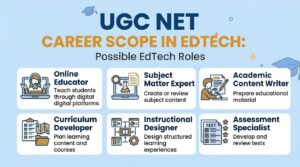
Possible EdTech Roles
| Role | Main Work |
| Online Educator | Teach students through digital platforms |
| Subject Matter Expert | Create or review subject content |
| Academic Content Writer | Prepare educational material |
| Curriculum Developer | Plan learning content and courses |
| Instructional Designer | Design structured learning experiences |
| Assessment Specialist | Develop and review tests |
This field can be useful for candidates who are comfortable with technology and enjoy teaching or creating educational content. Your UGC NET qualification can strengthen your academic profile, but employers may also consider communication, teaching, writing and digital skills.
UGC NET Career Scope in Policy Research, NGOs
Candidates from subjects related to social sciences, economics, political science, public administration and similar areas may also explore policy research or NGO-related work.
Depending on the organisation, work can involve:
- Research
- Surveys
- Report preparation
- Programme evaluation
- Education projects
- Social-sector research
- Policy analysis
UGC NET is not a universal eligibility requirement for these positions. Each organisation decides its own criteria, so candidates should check the vacancy before applying.
UGC NET Career Scope in Public Sector Opportunities
Some candidates also consider PSUs and other public-sector organisations. The UGC NET framework allows UGC/NTA candidate data to be shared with PSUs and other organisations for recruitment processes in applicable cases. However, this does not mean that every PSU accepts UGC NET for recruitment.
This distinction is important.
| What UGC NET Can Do | What It Cannot Do |
| May make you relevant for selected recruitment | Does not guarantee a PSU job |
| Candidate data may be used for applicable recruitment | Does not mean every PSU accepts NET |
| Can support eligibility where prescribed | Does not replace the recruitment notification |
Always read the latest official notification before applying for any PSU opportunity.
UGC NET Career Scope According to Your Strengths
Your qualification is only one part of your career profile. Your personal strengths can also influence which route suits you.
| Your Strength | Career Areas to Explore |
| Good at explaining concepts | Teaching, online education |
| Strong research interest | PhD, research projects |
| Good academic writing | Publishing, content, research |
| Good communication | Teaching, training, consulting |
| Strong digital skills | EdTech, online education |
| Interested in social issues | Policy research, NGOs |
| Strong analytical skills | Research, assessment, consulting |
For example, two candidates with the same UGC NET subject may choose completely different careers. One may prefer classroom teaching, while another may enjoy research or academic content work.
UGC NET Qualification Guarantee not a Job
This is one of the most important things candidates should understand about UGC NET career scope. Qualifying UGC NET can make you eligible for certain opportunities, but the final selection depends on the relevant university, organisation, recruitment body or admission process.
For example:
For Assistant Professor:
UGC NET-Vacancy-Application-Selection Process-Appointment
For PhD:
UGC NET-Find Suitable Programme-Apply-Admission Process-PhD
For Research Jobs:
UGC NET/JRF-Find Suitable Project-Apply-Selection
So, qualifying the examination is an important achievement, but you still need to take the next steps.
UGC NET Career Scope After UGC NET
A NET qualification gives you a strong academic base. You can make that profile stronger by adding practical skills and experience.
-
Build Research Experience
-
-
- If research interests you, work on research projects, academic papers and research methodology.
-
-
Improve Communication
-
-
- Good subject knowledge becomes more useful when you can explain difficult concepts clearly.
-
-
Develop Digital Skills
-
-
- Online teaching, content development and EdTech roles often require comfort with digital tools.
-
-
Keep Your Academic CV Updated
-
-
- Add relevant qualifications, publications, projects, teaching experience, certifications and academic achievements.
-
-
Track Vacancies Regularly
-
-
- Do not wait until you hear about a vacancy from someone else. Follow relevant university, research institute and recruitment websites.
-
-
Choose Opportunities Based on Your Goal
-
- Applying for every job after NET may not be the best strategy. Select opportunities that match your subject, skills and long-term plans.
UGC NET Career Scope Short-Term vs Long-Term Options
Some opportunities can help you start earning or gain experience quickly, while others are designed for long-term academic growth.
| Short-Term/Entry Options | Long-Term Career Direction |
| Guest Faculty | Assistant Professor |
| Online Tutor | Academic teaching |
| Academic Content Writer | Publishing/content leadership |
| Research Assistant | Senior research roles |
| Project Fellow | Research career |
| Subject Matter Expert | Education specialist |
| Project-based roles | Research/academic positions |
The best choice depends on your current situation. A temporary role can sometimes help you gain experience while you continue preparing for a long-term position.
UGC NET a Good Career Option
UGC NET itself is an examination, not a career. Its value comes from the opportunities it can help you access. For a candidate who wants to become a teacher, it can be an important eligibility qualification. For someone interested in research, JRF and PhD can provide a strong academic route. For others, the subject knowledge and academic skills can be used in EdTech, content, publishing, training or research-related work.
Therefore, the answer depends on what you want to achieve after qualifying.
UGC NET Career Scope Final Takeaway
UGC NET offers career options beyond a single job. Teaching and research are the main paths, while candidates can also explore PhD, EdTech, academic content, publishing, training and related fields. The right career path depends on your qualification category, subject, skills and career goals. A JRF candidate may choose research or PhD, while others may focus on Assistant Professor jobs or education-related roles.