




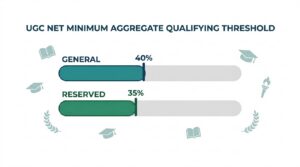
The UGC NET Qualifying Criteria 2026 is based on marks scored in both Paper 1 and Paper 2. Candidates must appear in both papers and secure the required aggregate marks. The minimum requirement is 40% for General and General-EWS candidates and 35% for reserved categories. However, these marks alone do not guarantee qualification, as the marks needed to qualify may be higher for different subjects and categories.
UGC NET Qualifying Criteria 2026
UGC NET qualification is decided using the combined performance of Paper 1 and Paper 2.
Candidates must:
- Appeared in both Paper 1 and Paper 2.
- Secure at least the prescribed minimum aggregate percentage.
- Meet the applicable subject-wise and category-wise cut-off.
- Satisfy the eligibility requirements for the qualification category they are seeking.

The minimum aggregate marks are:
| Category | Minimum Aggregate Marks |
| General/Unreserved | 40% |
| General-EWS | 40% |
| OBC-NCL | 35% |
| SC | 35% |
| ST | 35% |
| PwBD | 35% |
| Third Gender | 35% |
The marks are calculated by taking the performance of both papers together. There is no separate minimum percentage prescribed for Paper 1 and Paper 2 under this basic qualifying threshold.
UGC NET Qualifying Criteria 2026 Marks Require
UGC NET consists of two papers carrying a total of 300 marks.
- Paper 1: 100 marks
- Paper 2: 200 marks
- Total: 300 marks
Based on the minimum aggregate requirement:
| Category | Minimum Percentage | Minimum Marks out of 300 |
| General/Unreserved | 40% | 120 |
| General-EWS | 40% | 120 |
| OBC-NCL | 35% | 105 |
| SC | 35% | 105 |
| ST | 35% | 105 |
| PwBD | 35% | 105 |
| Third Gender | 35% | 105 |
These figures represent the minimum marks required to enter the qualification process. They should not be treated as the final cut-off for JRF, Assistant Professor or PhD admission.
UGC NET Qualifying Criteria 2026 40% Enough to Qualify
A General or General-EWS candidate needs at least 40% aggregate marks in both papers to be considered under the qualifying process. But UGC NET qualification is also based on the applicable subject-wise and category-wise cut-off.
- For example, a candidate scoring exactly 40% may satisfy the basic minimum requirement but may still not be declared qualified if the final cut-off for the candidate’s subject and category is higher.
- This is why candidates should not confuse minimum qualifying marks with the final UGC NET cut-off.
UGC NET Qualifying Criteria 2026 35% Enough to Qualify
No, not by itself. Candidates belonging to OBC-NCL, SC, ST, PwBD and Third Gender categories need at least 35% aggregate marks in both papers to enter the qualification process. However, the marks needed to qualify may be higher depending on the subject, category and number of available slots.
UGC NET Qualifying Criteria 2026 6% Rule
Under the result methodology, the number of candidates qualifying for Assistant Professor eligibility is set at 6% of candidates who appeared in both papers, followed by category-wise and subject-wise allocation.

UGC NET Qualifying Criteria 2026 Cut Off Decide
UGC NET does not have one common cut-off for all subjects and categories.
The qualification process broadly works in the following way:
Step 1: Determining the Qualification Pool
The number of candidates qualifying for Assistant Professor eligibility is set at 6% of the candidates who appeared in both papers, subject to the prescribed methodology.
Step 2: Category-Wise Allocation
The available qualification slots are distributed among categories according to the applicable Government of India reservation policy.
Step 3: Applying the Minimum Marks
Candidates must first have appeared in both papers and secured at least:
- 40% aggregate for General/Unreserved and General-EWS candidates
- 35% aggregate for OBC-NCL, SC, ST, PwBD and Third Gender candidates
Step 4: Subject-Wise and Category-Wise Cut Off
The qualifying candidates for each subject and category are then determined according to the prescribed methodology.
The aggregate marks corresponding to the available slots determine the final qualifying cut-off for that subject and category.
Therefore, the actual cut-off can be considerably higher than the basic 40% or 35% threshold.
UGC NET Qualifying Criteria 2026 for JRF
JRF qualification has an additional competition for the available JRF slots.
- Candidates must first meet the basic qualifying requirements. The JRF slots are then allocated among categories according to the applicable reservation policy.
- Therefore, a candidate who meets the minimum qualifying percentage does not automatically receive JRF.
- JRF also has a separate age eligibility condition, which is different from the minimum marks requirement.

UGC NET Qualifying Criteria 2026 for Assistant Professor
For Assistant Professor eligibility, candidates have to meet the minimum aggregate requirement and the relevant subject-wise and category-wise cut-off.
The UGC-NET result can place a candidate in the category of:
- JRF and Assistant Professor
- Assistant Professor and PhD admission
- PhD admission only
Candidates qualifying only for Assistant Professor are governed by the recruitment rules of the concerned university, college or State Government when applying for a teaching post.
UGC NET Qualifying Criteria 2026 for PhD Admission
UGC-NET can also be used for admission to PhD programmes under the applicable UGC-NET framework.
- Candidates may qualify under the category of Assistant Professor and PhD admission or PhD admission only, depending on the result and applicable rules.
- However, qualifying UGC NET does not mean automatic admission to a PhD programme. The concerned university or Higher Educational Institution follows its own applicable admission and selection rules.
UGC NET Cut Off vs Minimum Qualifying Marks
These two terms are often used interchangeably, but they mean different things.
| Minimum Qualifying Marks | Final Cut Off |
| 40% for General/General-EWS | Varies by subject and category |
| 35% for specified reserved categories | Can be higher than 35% |
| Allows the candidate to enter the qualification process | Determines the candidates actually qualifying |
| Same basic threshold across applicable categories | Changes according to subject and category |
The minimum qualifying marks are fixed thresholds, whereas the final cut-off is determined after the prescribed qualification methodology is applied.
NTA releases the final cut-off separately for subjects and categories. For the June 2026 examination, NTA published subject-wise and category-wise cut-off information along with the result.
UGC NET Qualifying Criteria 2026 for Paper 1 and Paper 2
No separate 40% or 35% passing requirement is applied to each paper under the basic qualifying criterion.
- The requirement is based on the aggregate marks obtained in both papers together.
- For example, a candidate may score fewer marks in Paper 1 and more marks in Paper 2. What matters for the minimum qualifying threshold is the combined performance across both papers.
- However, candidates still need to appear in both papers to be considered under the result methodology.
UGC NET Qualifying Criteria 2026 Normalisation
When an examination is conducted in multiple shifts, the difficulty level of the question papers may vary slightly between shifts.
- To maintain fairness, the exam authority may use a prescribed normalisation method to convert raw marks into normalised scores or NTA Scores during the result preparation process.
- Because of this, candidates should not directly compare raw marks obtained in different shifts.
- The final score or rank may depend on the applicable normalisation procedure used by the exam authority.
UGC NET Qualification Criteria 2026 Important Points
Candidates should remember the following points:
- Both Paper 1 and Paper 2 must be attempted.
- The minimum aggregate requirement is 40% for General/General-EWS candidates.
- The minimum aggregate requirement is 35% for OBC-NCL, SC, ST, PwBD and Third Gender candidates.
- The minimum marks are calculated using both papers together.
- Meeting the minimum percentage does not guarantee final qualification.
- Final cut-offs vary according to subject and category.
- JRF qualification depends on the available JRF slots and prescribed methodology.
- Assistant Professor qualification and JRF are not the same result category.
- PhD admission depends on the applicable rules of the concerned Higher Educational Institution.
- Candidates should check the latest NTA result notice and cut-off before interpreting their score.
UGC NET Qualifying Criteria 2026 Quick Summary
Before looking at the detailed rules, here is a quick summary of the UGC NET qualifying criteria 2026 to help you understand the key requirements at a glance.
| Particular | Requirement |
| Total Papers | 2 |
| Total Marks | 300 |
| General/Unreserved Minimum | 40% |
| General-EWS Minimum | 40% |
| OBC-NCL Minimum | 35% |
| SC Minimum | 35% |
| ST Minimum | 35% |
| PwBD Minimum | 35% |
| Third Gender Minimum | 35% |
| Papers Considered | Paper 1 + Paper 2 |
| Assistant Professor Qualification Pool | 6% of candidates appearing in both papers |
| Final Cut Off | Subject-wise and category-wise |
| JRF | Depends on available JRF slots and prescribed methodology |
Final Words
Understanding the UGC NET Qualifying Criteria 2026 is important before you start preparing for the exam. Candidates first need to meet the minimum marks requirement in both papers. However, simply meeting this requirement does not guarantee qualification.
The final result depends on the prescribed qualifying process, including the subject-wise and category-wise cut-off. JRF selection also follows separate criteria. So, focus on the complete exam pattern, syllabus, previous-year cut-offs and regular practice instead of preparing only to meet the minimum marks.