


UGC NET Reservation Criteria is important for candidates who belong to reserved categories and want to understand the benefits and rules applicable to them. The National Testing Agency (NTA) follows the Government of India’s reservation policy for UGC NET. These rules cover categories such as SC, ST, OBC-NCL, EWS, PwD/PwBD and Third Gender.
Why is UGC NET Reservation Criteria Important?
The UGC NET Reservation Criteria is important because reservation rules affect how candidates are considered for NET qualification and JRF. Candidates from reserved categories need to understand the rules that apply to their category before filling out the application form.
Understanding the reservation criteria helps candidates:
- Check whether they are eligible for reservation benefits.
- Select the correct category while filling out the UGC NET application form.
- Understand the minimum qualifying marks applicable to their category.
- Know how category-wise cut-offs and JRF allocation work.
- Check whether they need a valid certificate or other category-related documents.
For example, an OBC candidate must check whether they fall under the OBC-NCL category as per the Central List, because simply belonging to an OBC category in a state does not automatically mean that the candidate can claim OBC-NCL benefits in UGC NET.
Therefore, candidates should check the latest UGC NET notification and information bulletin before applying. Reservation rules and category-related requirements should not be assumed from previous years.

UGC NET Reservation Criteria 2026 Category-Wise Details
The reservation percentages mentioned in the June 2026 UGC-NET Information Bulletin are given below:
| Category | Reservation |
| Scheduled Caste (SC) | 15% |
| Scheduled Tribe (ST) | 7.5% |
| Other Backward Classes – Non-Creamy Layer (OBC-NCL) | 27% |
| General-Economically Weaker Section (EWS) | 10% |
| Persons with Benchmark Disabilities (PwBD) | 5% horizontal reservation |
The 5% PwBD reservation is applied horizontally across the above categories for candidates with 40% or more benchmark disability, as specified in the UGC-NET June 2026 bulletin.
UGC NET Reservation Criteria 2026 SC Candidates
Candidates belonging to the Scheduled Caste (SC) category are covered under the Government of India reservation policy applicable to UGC-NET.
- A 15% reservation is provided for SC candidates under the reservation framework mentioned in the June 2026 Information Bulletin.
- SC candidates also receive relaxation in certain UGC-NET eligibility conditions. For example, the minimum marks required in a Master’s degree are lower for SC candidates than for General candidates.
UGC NET Reservation Criteria 2026 ST Candidates
The Scheduled Tribe (ST) category has a 7.5% reservation under the applicable reservation policy.
- ST candidates are also included among the categories eligible for relaxation in the minimum percentage required in the qualifying Master’s degree and in the minimum aggregate marks required for UGC-NET qualification.
UGC NET Reservation Criteria 2026 OBC-NCL
The UGC NET reservation rules for OBC candidates apply specifically to Other Backward Classes belonging to the Non-Creamy Layer (OBC-NCL).
- A 27% reservation is provided for OBC-NCL candidates under the Central reservation framework.
- However, an important point is that State OBC lists cannot be used in place of the Central OBC-NCL List for claiming this benefit in UGC-NET.
- Candidates who belong to an OBC category in their State but are not included in the Central OBC-NCL List should select General/Unreserved instead of OBC-NCL in the application form.
OBC-NCL Reservation Rules
Candidates claiming OBC-NCL benefits should check:
- Their community is included in the Central List of OBCs.
- They fulfil the applicable Non-Creamy Layer conditions.
- Their category details are entered correctly in the application form.
- The required certificate and documents are available when required for verification.
The Central List is maintained by the National Commission for Backward Classes
(NCBC).

UGC NET Reservation Criteria 2026 EWS
The Economically Weaker Sections (EWS) category has a 10% reservation under the Government of India reservation framework applicable to Central Educational Institutions.
- For UGC-NET, General-EWS candidates are treated separately from the other reserved categories. This information refers to the Government of India instructions governing EWS reservation in Central Educational Institutions.
- Candidates claiming EWS benefits should have the required EWS certificate and satisfy the applicable income and asset conditions prescribed by the Government.
- It is important not to assume that simply belonging to a low-income family is enough. The candidate must meet the conditions prescribed for the EWS category and provide the required certification.
UGC NET Reservation Criteria 2026 PwBD
Persons with Benchmark Disabilities (PwBD) are covered under the reservation and accessibility provisions applicable to UGC-NET.
The 5% horizontal reservation for PwBD candidates with 40% or more disability within the specified categories. The bulletin refers to the Rights of Persons with Disabilities Act, 2016 for the definition of benchmark disability.
PwBD candidates may also receive examination facilities such as:
- Scribe or reader facility, where applicable
- Compensatory time
- Accessible examination arrangements
- Other facilities covered under the applicable government guidelines
For candidates eligible to use a scribe, the June 2026 bulletin provides for compensatory time of at least 20 minutes per hour of examination. For a three-hour examination, eligible candidates may receive a minimum additional time of one hour under the specified provisions.
A scribe is meant to assist the candidate in reading questions or entering answers according to the candidate’s directions. The scribe cannot explain questions or suggest answers.
Who can use a scribe?
- Blind candidates
- Candidates with cerebral palsy
- Candidates unable to write

UGC NET Reservation Criteria 2026 Minimum Qualifying Marks
Reservation also affects the minimum aggregate marks required for candidates to be considered for UGC NET qualification. The minimum qualifying marks are different for the General category and reserved categories.
| Category | Minimum Aggregate Marks in Both Papers |
| General/Unreserved | 40% |
| General-EWS | 40% |
| SC | 35% |
| ST | 35% |
| OBC-NCL | 35% |
| PwD/PwBD | 35% |
| Third Gender | 35% |
These are the minimum qualifying marks, not the final subject-wise cut-off.
Candidates who meet the minimum marks still need to satisfy the applicable category-wise and subject-wise cut-off for UGC NET qualification.
UGC NET Reservation Criteria 2026 Master’s Degree Eligibility
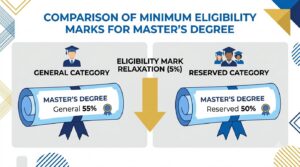
Reservation-related relaxation also applies to the minimum marks required in the qualifying Master’s degree. Candidates from different categories have different minimum percentage requirements for UGC NET eligibility.
- General/Unreserved and General-EWS candidates require at least 55% marks in the Master’s degree or an equivalent qualification.
- OBC-NCL, SC, ST, PwD/PwBD and Third Gender candidates require at least 50% marks.
This relaxation is separate from the reservation percentage. Candidates should not confuse reservation in JRF slots with relaxation in eligibility marks. Reservation determines category-wise provisions, while eligibility relaxation allows certain categories to apply with a lower minimum percentage in the qualifying degree.
UGC NET Reservation Criteria 2026 JRF
Reservation also plays an important role in the allocation of JRF slots. The total number of JRF slots is distributed among different categories according to the reservation policy of the Government of India.
- The subject-wise qualification process is then carried out as per the prescribed UGC NET methodology.
- Therefore, meeting the minimum qualifying marks does not automatically guarantee JRF. Candidates also need to meet the applicable category-wise and subject-wise requirements for JRF allocation.
UGC NET Reservation for Assistant Professor and PhD Admission
UGC-NET is used for different eligibility outcomes, including:
- JRF and Assistant Professor
- Assistant Professor and PhD admission
- PhD admission only
For Assistant Professor eligibility, candidates are governed by the recruitment rules of the concerned university, college or State Government, as applicable. For PhD admission, the concerned university or Higher Educational Institution follows its applicable admission rules.
Therefore, candidates should check the reservation rules of the concerned institution separately when applying for a particular Assistant Professor post or PhD programme.
Important UGC NET Reservation Rules for Candidates
Candidates should keep the following points in mind while applying for UGC-NET:
- Select the correct category in the application form.
- OBC candidates should check the Central OBC-NCL List before selecting OBC-NCL.
- State-list OBC status alone does not qualify a candidate for OBC-NCL reservation in UGC-NET.
- Keep the required category or disability documents ready.
- Check the prescribed format and validity requirements of certificates before using them.
- PwBD candidates should carefully select their disability category and required examination facilities.
- Do not provide false, incomplete or incorrect information to claim reservation benefits.
NTA states that reservation benefits are subject to document verification. If a candidate is found to have used a false, fake or incorrect document or provided false information to obtain reservation benefits, the candidate can be excluded from the examination process.
UGC NET Reservation Criteria 2026 Key Points
Here are the main points candidates should remember:
| Particular | Details |
| SC Reservation | 15% |
| ST Reservation | 7.5% |
| OBC-NCL Reservation | 27% |
| EWS Reservation | 10% |
| PwBD Reservation | 5% horizontal |
| Benchmark Disability | 40% or more, as applicable |
| General/EWS Minimum Qualifying Marks | 40% |
| Reserved Category Minimum Qualifying Marks | 35% |
| General/EWS Master’s Degree Requirement | 55% |
| OBC-NCL/SC/ST/PwD/PwBD Master’s Degree Requirement | 50% |
Conclusion
The UGC NET Reservation Criteria provides category-wise reservation and eligibility relaxations under the applicable Government of India rules. Candidates should select the correct category, check the latest requirements and keep the necessary documents ready. They should also remember that meeting the minimum qualifying marks does not guarantee the final cut-off, JRF or other UGC NET outcomes.