


UGC NET Conducted by the National Testing Agency (NTA) on behalf of the University Grants Commission (UGC), this exam is what makes lakhs of students across India sit for it every year, simply because it’s the only gateway to becoming an Assistant Professor or earning a Junior Research Fellowship (JRF).
UGC NET Syllabus
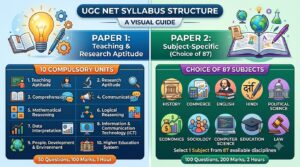
The UGC NET syllabus splits into two parts, and each one does a completely different job. Paper 1 stays the same for everyone, no matter which subject you pick. Paper 2, on the other hand, is entirely built around the subject you choose based on your postgraduate degree.
Do check the official UGC NET website before locking in your subject, as the December bulletin could shift some of these details.
- Paper 1 (General Paper on Teaching and Research Aptitude): 10 units, common to all candidates.
- Paper 2: the subject you select. The current list runs to 87 subjects, each carrying its own three-digit code.
- Questions: 50 in Paper 1, 100 in Paper 2 150 questions and 300 marks altogether.
- Timing: one continuous three-hour computer-based test, with no break and no negative marking.
- Where to find it: the bulletin points candidates to the UGC website for subject-wise syllabi NTA doesn’t send these out directly.
UGC NET Syllabus Includes
Many pages treat Paper 1 and Paper 2 as two separate exams with separate timings. That is wrong. The notification describes one test with two parts. Both parts are objective, multiple-choice and compulsory. The table below shows the UGC NET syllabus split by part.
| UGC NET syllabus part | Questions | Marks | What it tests |
| Part I (Paper 1): General Paper | 50 | 100 | Teaching and research aptitude, reasoning, comprehension, divergent thinking and general awareness |
| Part II (Paper 2): your subject | 100 | 200 | Domain knowledge of the subject you choose |
| Total | 150 | 300 | One continuous test of 3 hours (180 minutes), no break |
Each question carries 2 marks. Wrong answers do not lose marks, so you should attempt every question.
UGC NET Paper 1 Syllabus
Paper 1 has ten units in total. The official note says each unit gets five questions worth 2 marks a piece so every unit is worth 10 marks, and no unit weighs more than another. That’s good news for planning: you don’t need to guess which units matter most, because they all carry equal weight.
| UGC NET Paper 1 unit | Main topics from the official syllabus | Questions / marks | How to study it |
| Unit 1: Teaching Aptitude | Teaching concepts and levels, learner traits, teaching methods, ICT support, evaluation systems | 5 / 10 | Learn the definitions, then compare similar terms side by side |
| Unit 2: Research Aptitude | Types and methods of research, steps in research, thesis writing, referencing, research ethics | 5 / 10 | Build a one-page list of methods with real examples |
| Unit 3: Comprehension | A passage followed by questions on it | 5 / 10 | Practise passages against a timer |
| Unit 4: Communication | Types of communication, what makes it effective, barriers, mass media and society | 5 / 10 | Go through the concepts, then test yourself with questions |
| Unit 5: Mathematical Reasoning and Aptitude | Types of reasoning, number and letter series, codes, percentage, ratio, profit and loss, averages | 5 / 10 | Short daily practice beats one long weekly session |
| Unit 6: Logical Reasoning | Structure of arguments, fallacies, analogies, Venn diagrams, Indian logic (Pramanas) | 5 / 10 | Learn the key terms first, then move to argument-based questions |
| Unit 7: Data Interpretation | Types of data, graphs and charts, how to read them, data and governance | 5 / 10 | Practise reading tables and charts fast |
| Unit 8: ICT | Terminology, internet and email, digital moves in higher education, ICT and governance | 5 / 10 | Keep a short list of abbreviations handy |
| Unit 9: People, Development and Environment | Sustainable development goals, pollution, climate change, natural resources, hazards, environmental laws and agreements | 5 / 10 | Build a table of agreements with year and purpose |
| Unit 10: Higher Education System | Old and modern institutions, policies, governance, professional and skill education, value education | 5 / 10 | Track policy updates and note down the key bodies |
the official Paper 1 PDF straight from the source. Once you have it, head over to Vision JRF’s syllabus section to find study material that matches each topic.
Units 3, 5, 6 and 7 test skills, not memory, so daily practice will take you further than reading. Units 1, 2, 4, 8, 9 and 10 lean on concepts, so notes and revision work best here. The UGC NET Paper 1 theory book puts all the concept-based units together in one place.
UGC NET Paper 2 Syllabus
Paper 2 is where your chosen subject comes in. It runs to 100 questions worth 200 marks that’s two-thirds of the whole test. Every subject has its own official syllabus, split into units, and the number of units changes from subject to subject. Economics, for instance, opens with Micro Economics, Macro Economics, Statistics and Econometrics, while Commerce starts with Business Environment and International Business.
One thing the official notice doesn’t spell out is how many Paper 2 questions come from each unit. So if a page claims to know the exact unit-wise split for your subject, don’t take it at face value unless it names the official source.
How to pick your Paper 2 subject
- Start with the subject you did your Master’s in, and look it up in the subject table below.
- Not listed? Go with the closest related subject instead.
- Read that subject’s full official syllabus PDF before you lock in your decision.
- Note down the subject code you will need it while filling the application form.
- Check the medium too. Question papers come in English and Hindi, except for language papers.
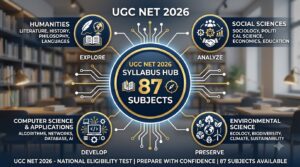
UGC NET Exam 87 Subjects
The UGC NET examination is conducted for subjects across various disciplines. Candidates can select their preferred subject while filling out the application form based on their educational qualification and the subjects available under UGC NET.
UGC NET subject codes and subject names
The table below provides the UGC NET subject codes and subject names.
| S. No. | Subject Code | Subject Name |
| 1 | 001 | Economics |
| 2 | 002 | Political Science |
| 3 | 003 | Philosophy |
| 4 | 004 | Psychology |
| 5 | 005 | Sociology |
| 6 | 006 | History |
| 7 | 007 | Anthropology |
| 8 | 008 | Commerce |
| 9 | 009 | Education |
| 10 | 010 | Social Work |
| 11 | 011 | Defence and Strategic Studies |
| 12 | 012 | Home Science |
| 13 | 014 | Public Administration |
| 14 | 015 | Population Studies |
| 15 | 016 | Music |
| 16 | 017 | Management |
| 17 | 018 | Maithili |
| 18 | 019 | Bengali |
| 19 | 020 | Hindi |
| 20 | 021 | Kannada |
| 21 | 022 | Malayalam |
| 22 | 023 | Odia |
| 23 | 024 | Punjabi |
| 24 | 025 | Sanskrit |
| 25 | 026 | Tamil |
| 26 | 027 | Telugu |
| 27 | 028 | Urdu |
| 28 | 029 | Arabic |
| 29 | 030 | English |
| 30 | 031 | Linguistics |
| 31 | 032 | Chinese |
| 32 | 033 | Dogri |
| 33 | 034 | Nepali |
| 34 | 035 | Manipuri |
| 35 | 036 | Assamese |
| 36 | 037 | Gujarati |
| 37 | 038 | Marathi |
| 38 | 039 | French |
| 39 | 040 | Spanish |
| 40 | 041 | Russian |
| 41 | 042 | Persian |
| 42 | 043 | Rajasthani |
| 43 | 044 | German |
| 44 | 045 | Japanese |
| 45 | 046 | Adult Education |
| 46 | 047 | Physical Education |
| 47 | 049 | Arab Culture and Islamic Studies |
| 48 | 050 | Indian Culture |
| 49 | 055 | Labour Welfare / HRM |
| 50 | 058 | Law |
| 51 | 059 | Library and Information Science |
| 52 | 060 | Buddhist, Jaina and Gandhian Studies |
| 53 | 062 | Comparative Study of Religions |
| 54 | 063 | Mass Communication and Journalism |
| 55 | 065 | Performing Arts |
| 56 | 066 | Museology and Conservation |
| 57 | 067 | Archaeology |
| 58 | 068 | Criminology |
| 59 | 070 | Tribal and Regional Language |
| 60 | 071 | Folk Literature |
| 61 | 072 | Comparative Literature |
| 62 | 073 | Sanskrit Traditional Subjects |
| 63 | 074 | Women Studies |
| 64 | 079 | Visual Art |
| 65 | 080 | Geography |
| 66 | 081 | Social Medicine and Community Health |
| 67 | 082 | Forensic Science |
| 68 | 083 | Pali |
| 69 | 084 | Kashmiri |
| 70 | 085 | Konkani |
| 71 | 087 | Computer Science and Applications |
| 72 | 088 | Electronic Science |
| 73 | 089 | Environmental Sciences |
| 74 | 090 | Politics (International Relations) |
| 75 | 091 | Prakrit |
| 76 | 092 | Human Rights and Duties |
| 77 | 093 | Tourism Administration and Management |
| 78 | 094 | Bodo |
| 79 | 095 | Santali |
| 80 | 100 | Yoga |
| 81 | 101 | Sindhi |
| 82 | 102 | Hindu Studies |
| 83 | 103 | Indian Knowledge System |
| 84 | 104 | Disaster Management |
| 85 | 105 | Ayurveda Biology |
| 86 | 106 | Forestry |
| 87 | 107 | Statistics |
Official UGC NET Syllabus PDF
The bulletin says syllabi for all subjects are on the UGC syllabus page, ugcnetonline.in, and NTA will not send them to any candidate. Each subject has a PDF, mostly in English and Hindi. Follow these steps.
- Open the official NTA UGC NET site and read the current bulletin. Section 2.3 names the syllabus page.
- Open that UGC syllabus page and pick your subject by name and code.
- Download the Paper 1 PDF (code 00) and your Paper 2 PDF.
- Check the cycle and date on the source. Old PDFs and old blog posts still circulate.
Updated Syllabi of UGC-NET (Applicable from June 2019 UGC-NET Onwards)
The subjects with their respective codes are given below :
| Code | Subject | English PDF | Hindi PDF |
| 00 | Paper 1 (General Paper) | English | Hindi |
| 01 | Economics / Rural Economics / Co-operation / Demography / Development Planning / Development Studies / Econometrics / Applied Economics / Development Eco. / Business Economics | English | Hindi |
| 02 | Political Science | English | Hindi |
| 03 | Philosophy | English | Hindi |
| 04 | Psychology | English | Hindi |
| 05 | Sociology | English | Hindi |
| 06 | History | English | Hindi |
| 07 | Anthropology | English | Hindi |
| 08 | Commerce | English | Hindi |
| 09 | Education | English | Hindi |
| 10 | Social Work | English | Hindi |
| 11 | Defence and Strategic Studies | English | Hindi |
| 12 | Home Science | English | Hindi |
| 14 | Public Administration | English | Hindi |
| 15 | Population Studies | English | Hindi |
| 16 | Music | English | Hindi |
| 17 | Management (Business Admn. / Marketing / Industrial Relations / Personnel Mgt. / Financial Mgt. / Co-operative Mgt.) | English | Hindi |
| 18 | Maithili | Maithili | Same |
| 19 | Bengali | Bengali | Same |
| 20 | Hindi | — | Hindi |
| 21 | Kannada | Kannada | Same |
| 22 | Malayalam | Malayalam | Same |
| 23 | Odia | Odia | Same |
| 24 | Punjabi | Punjabi | Same |
| 25 | Sanskrit | English | Hindi |
| 26 | Tamil | Tamil | Same |
| 27 | Telugu | Telugu | Same |
| 28 | Urdu | Urdu | Same |
| 29 | Arabic | Arabic | Same |
| 30 | English | English | Same |
| 31 | Linguistics | English | Hindi |
| 32 | Chinese | Chinese | Same |
| 33 | Dogri | Dogri | Same |
| 34 | Nepali | Nepali | Same |
| 35 | Manipuri | Manipuri | Same |
| 36 | Assamese | Assamese | Same |
| 37 | Gujarati | Gujarati | Same |
| 38 | Marathi | Marathi | Same |
| 39 | French | English | French |
| 40 | Spanish | Spanish | Same |
| 41 | Russian | English | Russian |
| 42 | Persian | Persian | Same |
| 43 | Rajasthani | Hindi | Same |
| 44 | German | German | Same |
| 45 | Japanese | Japanese | Same |
| 46 | Adult Education / Continuing Education / Andragogy / Non-Formal Education | English | Hindi |
| 47 | Physical Education | English | Hindi |
| 49 | Arab Culture and Islamic Studies | English | Hindi |
| 50 | Indian Culture | English | Hindi |
| 55 | Labour Welfare / Personnel Mgt. / Industrial Relations / HRM | English | Hindi |
| 58 | Law | English | Hindi |
| 59 | Library and Information Science | English | Hindi |
| 60 | Buddhist, Jaina, Gandhian and Peace Studies | English | Hindi |
| 62 | Comparative Study of Religions | English | Hindi |
| 63 | Mass Communication and Journalism | English | Hindi |
| 65 | Performing Art — Dance / Drama / Theatre | English | Hindi |
| 66 | Museology and Conservation | English | Hindi |
| 67 | Archaeology | English | Hindi |
| 68 | Criminology | English | Hindi |
| 70 | Tribal and Regional Language / Literature | English | Hindi |
| 71 | Folk Literature | English | Hindi |
| 72 | Comparative Literature | English | Hindi |
| 73 | Sanskrit Traditional Subjects (Jyotisha, Vyakarna, Mimansa, Nyaya, etc.) | — | Hindi |
| 74 | Women Studies | English | Hindi |
| 79 | Visual Art (Drawing/Painting, Sculpture, Applied Art, History of Art) | English | Hindi |
| 80 | Geography | English | Hindi |
| 81 | Social Medicine and Community Health | English | Hindi |
| 82 | Forensic Science | English | Hindi |
| 83 | Pali | English | Hindi |
| 84 | Kashmiri | Kashmiri | Same |
| 85 | Konkani | Konkani | Same |
| 87 | Computer Science and Applications | English | English only |
| 88 | Electronic Science | English | English only |
| 89 | Environmental Sciences | English | English only |
| 90 | Politics incl. International Relations / Area Studies (West Asian, South East Asian, African, South Asian, Soviet, American) | English | Hindi |
| 91 | Prakrit | English | Hindi |
| 92 | Human Rights and Duties | English | Hindi |
| 93 | Tourism Administration and Management | English | Hindi |
| 94 | Bodo | — | Hindi |
| 95 | Santali | — | Hindi |
| 100 | Yoga | English | Hindi |
| 101 | Sindhi | Arabic script | Hindi |
| 102 | Hindu Studies | English | Hindi |
| 103 | Indian Knowledge System | English | Hindi |
| 104 | Disaster Management | English | Hindi |
| 105 | Ayurveda Biology | English | Hindi |
| 106 | Forestry | English | Hindi |
| 107 | Statistics | English | Hindi |
UGC NET Syllabus to Plan Your Preparation
A syllabus is a checklist, not a reading list. Turn it into units, then into weeks. The plan below fits a candidate who has around two months. Adjust the weeks if you have more or less time.
Follow an 8-week split
Paper 1 and Paper 2 run together, so study a little of both every day. This UGC NET syllabus plan is a suggestion, not an official schedule.
| UGC NET syllabus 8-week plan | Paper 1 focus | Paper 2 focus |
| Weeks 1 to 2 | Units 1, 2 and 4 (concepts) | First read of the first units of your subject |
| Weeks 3 to 4 | Units 5, 6 and 7 (reasoning and data) | Middle units of your subject |
| Weeks 5 to 6 | Units 8, 9 and 10 plus comprehension practice | Remaining units of your subject |
| Week 7 | Full revision of all 10 units | Full revision of all units |
| Week 8 | Timed mock tests, weak units only | Timed mock tests, weak units only |
Practice makes the syllabus real. Solve previous year papers to see how each unit appears in questions, then attempt the UGC NET test series for timed practice. If you want a guided route, see the UGC NET / JRF courses at Vision JRF.
Next Steps After Syllabus
Once your subject and units are clear, fix your timeline. The UGC NET December dates guide lists the application and exam dates. Then start your first unit today.
UGC NET Exam Medium
Choosing your medium is an important step.
| UGC NET syllabus in Hindi: medium rules | What the bulletin says |
| Languages of the question paper | English and Hindi only, except language papers |
| When you choose | While filling the online application form |
| Can you change it? | No. The option once exercised cannot be changed |
| Language of your answers | You answer in the medium you chose in the form |
| If a question is unclear in translation | The English version is treated as final |
Watch this session: UGC NET JRF History | Medieval India Marathon Complete Syllabus Revision.