




UGC NET is a national-level exam conducted by the National Testing Agency (NTA) on behalf of the UGC. It is used to determine eligibility for Junior Research Fellowship (JRF), Assistant Professor and PhD admission, depending on the candidate’s result category.
UGC NET Full Form
UGC NET stands for University Grants Commission National Eligibility Test. It is a national-level test that checks whether an Indian national is eligible for the Junior Research Fellowship (JRF), appointment as an Assistant Professor, or admission to a Ph.D. The National Testing Agency (NTA) conducts the exam for the University Grants Commission (UGC).
- Full Form: University Grants Commission National Eligibility Test
- Conducted By: National Testing Agency (NTA) for UGC
- It Is: An eligibility test, not a degree or a job
- It Leads To: JRF, Assistant Professor eligibility and Ph.D. admission

UGC NET Meaning
To understand the UGC NET exam better, let us first look at its meaning, purpose, eligibility, and role in a teaching or research career.
| UGC NET full form: word by word | What it means |
| UGC | University Grants Commission. A statutory body of the Government of India under the Ministry of Education. It funds universities and sets standards in higher education. |
| NET | National Eligibility Test. A test that decides your eligibility, not a course you attend. |
| NTA | National Testing Agency. The autonomous body that runs the test on UGC’s behalf. |
| JRF | Junior Research Fellowship. A fellowship for research, offered to top performers. |
UGC NET does not teach you how to become a teacher or researcher. It simply checks whether you are qualified to teach or do research in Indian universities and colleges.
What Is UGC NET Used For?
UGC NET is mainly used to check whether a candidate is qualified for teaching or research opportunities in Indian universities and colleges.
UGC NET can help you in three different ways. Your result decides which category you qualify for. The UGC NET table divides these into three categories. Let’s understand what each category means and what you can do with it.
| UGC NET result category | JRF | Assistant Professor | Ph.D. admission |
| Category 1: JRF and Assistant Professor | Yes | Yes | Yes |
| Category 2: Assistant Professor and Ph.D. admission | No | Yes | Yes |
| Category 3: Ph.D. admission only | No | No | Yes |
Junior Research Fellowship (JRF)
- A JRF qualifier can receive a UGC fellowship for research, if a university, IIT or institution gives them a place.
- The offer is valid for three years from the date of the JRF award letter. JRF holders are also eligible to be Assistant Professors.
- Your JRF letter is valid for three years from the date written on it. For example, if your letter is dated 10 January 2027, you can take admission any time before January 2030. With JRF, you can also become an Assistant Professor.
Assistant Professor
- To become an Assistant Professor in a university or college, you must pass NET, SET or SLET.
- This is the minimum need. A few people do not need it, but only when UGC rules say so. Passing the exam does not give you a job.
- The university, college or State government that has the vacancy has its own way of choosing people. You must pass that selection too.
Ph.D. admission
- Some students pass NET in Category 2 or Category 3. These students can use their NET score to get a Ph.D. seat.
- They do not have to write a separate entrance test for each university.
- The university gives 70 out of 100 marks for your NET score and 30 out of 100 marks for your interview.
- The interview is also called a viva. Your NET score works for only one year from the day the result comes out. So you should apply for your Ph.D. within that year.
- This 70 and 30 rule is only for Category 2 and Category 3. If you have JRF (Category 1), the university chooses you through an interview.

Who conducts UGC NET?
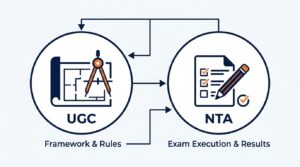
Two bodies work on it, and each has its own job. UGC (University Grants Commission) decides the rules. NTA (National Testing Agency) holds the exam. NTA is an autonomous body under the Ministry of Education, and UGC hands it the work of running the test. That’s why you often see the name NTA UGC NET.
UGC vs NTA
Many students get confused about the roles of UGC and NTA. Both are connected with UGC NET, but their responsibilities are different.
| UGC | NTA |
| University Grants Commission | National Testing Agency |
| Sets the broader rules and framework for UGC NET | Conducts the UGC NET examination |
| Works on standards for higher education | Manages the application process |
| Prescribes the subject-related framework and syllabus | Conducts the exam in Computer Based Test (CBT) mode |
| Decides the eligibility framework and qualifying rules | Releases exam notices, admit cards and other updates |
| Oversees the broader academic and regulatory framework | Processes and declares the examination results |
UGC NET Exam Highlights
Before moving ahead, let’s take a quick look at the UGC NET Exam Highlights to understand the exam pattern, important dates, eligibility, and other key details at a glance.
| Particulars | Details |
| Exam Name | UGC NET (University Grants Commission National Eligibility Test) |
| Conducting Body | National Testing Agency (NTA) |
| Conducted For | JRF, Assistant Professor & PhD admission, as applicable |
| Exam Mode | Computer-Based Test (CBT) |
| Papers | Paper 1 and Paper 2 |
| Total Questions | 150 |
| Total Marks | 300 |
| Exam Duration | 3 hours |
| Negative Marking | No negative marking |
| December 2026 Exam Date | To be announced |
| Official Notification | To be announced |
| Application Form | To be announced |
| Official Website | UGC-NET official website |
- So, you do not get a separate time slot for Paper 1 and another for Paper 2. Both parts are completed in the same 180-minute exam session.
- The final thing to remember is that your UGC NET result is based on your performance across both parts of the examination. The official UGC-NET website also confirms that the test is conducted in Computer Based Test (CBT) mode.
- Part I tests teaching and research aptitude, reasoning, reading comprehension and general awareness. Part II tests the subject you choose. All questions are compulsory.
UGC NET A Qualification or a Government Job?
Many students get confused about UGC NET is not a government job, and it is not a degree. It is an eligibility test. When you qualify, you become eligible for certain opportunities, but you do not get a job automatically.
- It is not a job: You do not receive an appointment letter simply because you qualify UGC NET. The concerned university, college or recruiting authority selects candidates for available posts according to its rules.
- It is not a degree: UGC NET does not replace your Master’s degree or PhD. It is an eligibility test.
- It is an eligibility test: Qualifying NET can make you eligible for Assistant Professor recruitment, subject to the applicable recruitment rules and other requirements.
- JRF is a fellowship: If you qualify for Junior Research Fellowship, you receive fellowship support for eligible research. JRF is not a permanent government job.
UGC NET can make you eligible for opportunities, but qualifying the exam does not itself give you a job or a degree.

UGC NET Eligibility Criteria
UGC NET is conducted for Indian nationals who want to become eligible for Junior Research Fellowship (JRF), Assistant Professor, or PhD admission, depending on the category in which they qualify.
- For most candidates, the basic requirement is a Master’s degree or an equivalent qualification from a recognised university or institution.
- You should also check whether your Master’s subject matches the UGC NET subject you want to appear for. If your exact subject is not available in the UGC NET subject list, you may be allowed to choose a related subject, depending on the applicable UGC-NET rules.
Minimum Marks in Master’s Degree
The minimum marks required are:
- General and EWS candidates: 55%
- OBC-NCL, SC, ST, PwD/PwBD and Third Gender candidates: 50%
There are also specific provisions for candidates who have completed a four-year Bachelor’s degree. Such candidates need to meet the prescribed percentage requirement under the current UGC-NET rules.
UGC NET Final-Year Students Apply
Candidates who are still completing their qualifying degree can apply in certain circumstances.
- However, their eligibility remains provisional until they complete the required qualification within the prescribed period.
- So, if you are in the final year of your Master’s degree, do not assume that you are automatically disqualified. Check the latest UGC-NET notification for the exact conditions that apply to your batch.
UGC NET Exam JRF Age Limit
For JRF, the latest applicable rules provide an upper age limit of 30 years, subject to relaxation for eligible categories. Age relaxation is available under specified rules for categories including:
| Category | Age Relaxation |
| OBC-NCL | As per applicable rules |
| SC | As per applicable rules |
| ST | As per applicable rules |
| PwD/PwBD | As per applicable rules |
| Third Gender | As per applicable rules |
| Women Candidates | As per applicable rules |
| Other eligible categories | As per applicable rules |
The exact cut-off date for calculating age should be checked in the December 2026 information bulletin once it is released.
| UGC NET Category | Age Limit |
| Assistant Professor | No upper age limit |
| PhD Admission | No upper age limit |
UGC NET Exam JRF Age Relaxation
Age relaxation is available to eligible categories under the applicable rules.
- Candidates should check the official notification for the exact relaxation applicable to their category.
- Do not rely only on a general age calculation because the important factor is the cut-off date specified by NTA.
UGC NET Exam Pattern
The UGC NET examination is divided into two papers Paper 1 and Paper 2. Both papers are conducted in the same examination session, and the complete test is of 3 hours. There is no separate break between the two papers.
UGC NET Exam Pattern
| Paper | Number of Questions | Marks | Nature of Paper |
| Paper 1 | 50 | 100 | Common for all candidates |
| Paper 2 | 100 | 200 | Subject-specific |
| Total | 150 | 300 | — |
Paper 1
Paper 1 is common for every UGC NET candidate, regardless of the subject chosen for Paper 2. It tests the candidate’s general teaching and research ability.
It covers areas such as:
- Teaching Aptitude
- Research Aptitude
- Reading Comprehension
- Communication
- Reasoning Ability
- Data Interpretation
- Information and Communication Technology (ICT)
- People, Development and Environment
- Higher Education System
- Mathematical and Logical Reasoning
Paper 1 contains 50 objective-type questions, with 2 marks for each question. Therefore, the paper carries a total of 100 marks.
Paper 2
- Paper 2 is based on the subject selected by the candidate while filling out the UGC NET application form. For example, a candidate choosing History will receive questions related to History, while a candidate choosing Commerce will answer questions from Commerce.
- Paper 2 contains 100 objective-type questions, with 2 marks for each question. It carries a total of 200 marks.
Total Exam Duration
- The total examination duration is 3 hours. Candidates have to complete both Paper 1 and Paper 2 within this time.
- Since Paper 2 carries 200 marks, it has a higher weightage than Paper 1. Candidates should therefore prepare Paper 1 for a strong overall score while giving sufficient time to their chosen subject for Paper 2.
Key Points to Remember
- UGC NET has two papers.
- Paper 1 has 50 questions and 100 marks.
- Paper 2 has 100 questions and 200 marks.
- The exam has 150 questions in total.
- The maximum marks are 300.
- Both papers contain objective-type questions.
- Paper 1 is common to all candidates.
- Paper 2 is based on the candidate’s selected subject.
- The total exam duration is 3 hours.
UGC NET Exam Marking Scheme
The marking scheme is straightforward.
| Response | Marks |
| Correct answer | +2 |
| Incorrect answer | 0 |
| Unanswered | 0 |
| Negative marking | No |
NTA’s June 2026 bulletin clearly states that each question carries two marks and that there is no negative marking for an incorrect response.
No marks are awarded for an unanswered question or a question marked for review without a valid response.
UGC NET Result
Your UGC NET result includes your marks and percentile/NTA Score. If a subject is conducted in more than one shift, NTA uses the prescribed normalisation process so that candidates from different shifts can be compared fairly.
What Does Percentile Mean?
Percentile is not the same as percentage.
- In simple words, your percentile tells you how your performance compares with other candidates who appeared for the test. It indicates the percentage of candidates who scored equal to or below your score.
- For example, a percentile of 90 means your performance was equal to or higher than roughly 90% of the candidates in the relevant calculation. It does not mean that you scored 90% marks in the examination.
What Are Normalised Marks?
When the same subject is conducted in multiple shifts, the raw marks from different shifts are processed using the prescribed Equi-percentile method.
- The result is then declared with the percentile and normalised marks.
- This matters because two candidates may have taken the same subject in different shifts. The normalisation process is used to bring their scores onto a common scale before the final qualification process.
What About National Fellowships?
Some fellowships connected with UGC NET are handled separately through the Ministry of Social Justice and Empowerment. The June 2026 bulletin specifically lists:
- National Fellowship for Scheduled Caste Students (NFSC)
- National Fellowship for Other Backward Classes (NFOBC)
- National Fellowship for Persons with Disabilities (NFPwD)
Their selection is governed by the relevant fellowship guidelines.
In Short
Getting 40% or 35% is only the minimum qualifying threshold.
- It does not by itself guarantee UGC NET qualification for Assistant Professor eligibility.
- Your final result depends on the prescribed qualification process, including the available slots, reservation, subject and category-wise cut-offs, and the applicable normalisation procedure.
UGC NET Exam Cut Off
The UGC NET Cut Off is released by NTA after the examination. The cut-off is different for each subject and category. Candidates need to check the cut-off for their subject, category and qualification category to know their qualifying status.
UGC NET cut-offs can vary based on factors such as:
- Subject
- Category
- Qualification category
- Number of candidates
- Applicable NTA rules
NTA also releases subject-wise, category-wise cut-off details after the result. Candidates should check the official NTA cut-off for the final qualifying status. Expected cut-offs shared by coaching websites should not be treated as final.
UGC NET Exam After passing
Now that you know what UGC NET is and what qualifying the exam actually means, let’s look at what you can do after passing UGC NET.
Junior Research Fellowship (JRF)
If you pass JRF, UGC gives you money to do research.
- This money is called a fellowship. But first, you need a seat in a university, an IIT or another institute.
- Your JRF letter is valid for three years from the date written on it.
- Say your letter is dated March 2026. Then you have time until March 2029 to find a seat, so you don’t need to panic. With JRF, you can also apply for Assistant Professor posts.
Assistant Professor
Do you want to teach in a college or university? Then you must pass NET, SET or SLET first. This is the minimum need.
- A few people get a relaxation, but only when UGC rules allow it. Remember, passing the exam does not give you the job.
- Every university, college or State government has its own way of choosing people, and you must pass that selection too. Think of NET as your entry ticket.
- It gets you into the queue, but you still have to win the race.
Ph.D. admission
Some students pass NET in Category 2 or Category 3. They can use their NET score to get a Ph.D. seat, so they do not need to write a separate entrance test for every university.
- The university gives 70 marks out of 100 for your NET score and 30 marks out of 100 for your interview. The interview is also called a viva.
- So even with a good NET score, a bad interview can pull you down.
- Your NET score works for only one year from the result date, so apply for your Ph.D. within that year.
- This 70 and 30 rule is only for Category 2 and Category 3.
- If you are a JRF student (Category 1), the university chooses you through an interview.
- I left out the last checking note from your text, because it was for you and not for readers. Keep the fact-check advice in mind if you use this in a final document.
UGC NET Career Path
Many readers know the UGC NET meaning but not which result they should aim for. The table below matches a common goal with the outcome you need.
| UGC NET goal | Result you need | Extra rule to remember |
| Paid research and a Ph.D. | Category 1 (JRF) | JRF has an upper age limit of 30 years as on 1 June 2026, with relaxation for some categories. |
| Teach in a college or university | Category 1 or Category 2 | The hiring institute’s own recruitment rules apply after you qualify. |
| Only a Ph.D. seat | Any category, including Category 3 | Ph.D. admission uses 70% NET marks and 30% interview. |
| Teaching job after a four-year bachelor’s degree | Not possible on that degree alone | A four-year degree can lead to JRF and Ph.D. but not Assistant Professor. |
UGC NET Exam Certificate and Validity
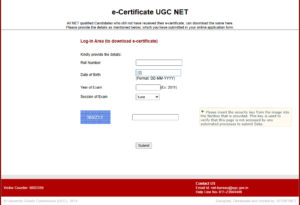
After qualifying UGC NET, candidates can download their e-certificate through the official NTA UGC-NET portal. NTA has been issuing e-certificates for different UGC NET sessions through its official website. The validity depends on the category for which the candidate qualifies.
Assistant Professor Eligibility
There is no expiry date for UGC NET qualification for Assistant Professor eligibility.
- The UGC states that the validity of the UGC-NET certificate for Assistant Professor/Lectureship is forever. However, actual recruitment is governed by the rules of the concerned university, college or state government.
JRF Validity
- The JRF award is valid for three years from the date of issue of the JRF Award Letter. Candidates need to find placement in a university, institution or other eligible organisation within the applicable validity period to receive the fellowship.
- For candidates who have already joined a PhD, the fellowship commencement date is governed by the applicable UGC rules mentioned in the information bulletin.
PhD Admission Category
- UGC NET can also be used for PhD admission under the applicable categories and rules. For candidates qualifying under the PhD admission categories, the NET marks are used according to the UGC’s PhD admission framework.
- The validity period for using NET for PhD admission can depend on the applicable category and admission rules.
- Candidates should therefore check the latest UGC/NTA notification and the rules of the concerned university before applying for PhD admission.
UGC NET Exam E-Certificate
NTA provides the UGC NET certificate through its online portal after the result and certificate-issuance process. Candidates can download the e-certificate from the official UGC-NET website and should keep it safely for future use.
UGC NET Certificate Validity
| Category | Validity |
| Assistant Professor | Forever |
| JRF | 3 years from the date of issue of JRF Award Letter |
| PhD Admission | As per applicable UGC/university admission rules |
| E-Certificate | Downloaded online after certificate issuance |
UGC NET Exam JRF vs Assistant Professor vs PhD
UGC NET can provide different opportunities depending on the category in which a candidate qualifies. JRF, Assistant Professor and PhD admission are not the same thing. The main difference is the purpose of each category.
| Category | Purpose | What It Means |
| JRF | Research + fellowship | Candidates can pursue research with JRF financial support, subject to applicable rules. |
| Assistant Professor | Teaching | Candidates become eligible to apply for Assistant Professor positions, subject to the recruitment rules of the concerned institution. |
| PhD Admission | Higher studies | Candidates can use their UGC NET qualification for PhD admission under the applicable UGC and university rules. |
JRF
Junior Research Fellowship (JRF) is mainly meant for candidates who want to pursue research. Along with research eligibility, JRF-qualified candidates can also be eligible for Assistant Professor positions, subject to applicable rules.
Assistant Professor
Candidates who qualify for Assistant Professor eligibility can apply for teaching positions in universities and colleges where UGC NET is an applicable eligibility requirement. However, qualifying UGC NET does not guarantee a job. Recruitment depends on vacancies and the rules of the concerned institution.
PhD Admission
UGC NET Exam qualification can also be used for PhD admission under the applicable UGC framework. The admission process, weightage and other requirements may depend on the university and the category under which the candidate qualifies.
JRF is mainly linked with research and fellowship, Assistant Professor is linked with teaching eligibility, while the PhD category is linked with admission to doctoral programmes.
UGC NET Exam Subjects
The UGC NET examination is conducted for subjects across various disciplines. Candidates can select their preferred subject while filling out the application form based on their educational qualification and the subjects available under UGC NET.
UGC NET subject codes and subject names
The table below provides the UGC NET subject codes and subject names.
| S. No. | Subject Code | Subject Name |
| 1 | 001 | Economics |
| 2 | 002 | Political Science |
| 3 | 003 | Philosophy |
| 4 | 004 | Psychology |
| 5 | 005 | Sociology |
| 6 | 006 | History |
| 7 | 007 | Anthropology |
| 8 | 008 | Commerce |
| 9 | 009 | Education |
| 10 | 010 | Social Work |
| 11 | 011 | Defence and Strategic Studies |
| 12 | 012 | Home Science |
| 13 | 014 | Public Administration |
| 14 | 015 | Population Studies |
| 15 | 016 | Music |
| 16 | 017 | Management |
| 17 | 018 | Maithili |
| 18 | 019 | Bengali |
| 19 | 020 | Hindi |
| 20 | 021 | Kannada |
| 21 | 022 | Malayalam |
| 22 | 023 | Odia |
| 23 | 024 | Punjabi |
| 24 | 025 | Sanskrit |
| 25 | 026 | Tamil |
| 26 | 027 | Telugu |
| 27 | 028 | Urdu |
| 28 | 029 | Arabic |
| 29 | 030 | English |
| 30 | 031 | Linguistics |
| 31 | 032 | Chinese |
| 32 | 033 | Dogri |
| 33 | 034 | Nepali |
| 34 | 035 | Manipuri |
| 35 | 036 | Assamese |
| 36 | 037 | Gujarati |
| 37 | 038 | Marathi |
| 38 | 039 | French |
| 39 | 040 | Spanish |
| 40 | 041 | Russian |
| 41 | 042 | Persian |
| 42 | 043 | Rajasthani |
| 43 | 044 | German |
| 44 | 045 | Japanese |
| 45 | 046 | Adult Education |
| 46 | 047 | Physical Education |
| 47 | 049 | Arab Culture and Islamic Studies |
| 48 | 050 | Indian Culture |
| 49 | 055 | Labour Welfare / HRM |
| 50 | 058 | Law |
| 51 | 059 | Library and Information Science |
| 52 | 060 | Buddhist, Jaina and Gandhian Studies |
| 53 | 062 | Comparative Study of Religions |
| 54 | 063 | Mass Communication and Journalism |
| 55 | 065 | Performing Arts |
| 56 | 066 | Museology and Conservation |
| 57 | 067 | Archaeology |
| 58 | 068 | Criminology |
| 59 | 070 | Tribal and Regional Language |
| 60 | 071 | Folk Literature |
| 61 | 072 | Comparative Literature |
| 62 | 073 | Sanskrit Traditional Subjects |
| 63 | 074 | Women Studies |
| 64 | 079 | Visual Art |
| 65 | 080 | Geography |
| 66 | 081 | Social Medicine and Community Health |
| 67 | 082 | Forensic Science |
| 68 | 083 | Pali |
| 69 | 084 | Kashmiri |
| 70 | 085 | Konkani |
| 71 | 087 | Computer Science and Applications |
| 72 | 088 | Electronic Science |
| 73 | 089 | Environmental Sciences |
| 74 | 090 | Politics (International Relations) |
| 75 | 091 | Prakrit |
| 76 | 092 | Human Rights and Duties |
| 77 | 093 | Tourism Administration and Management |
| 78 | 094 | Bodo |
| 79 | 095 | Santali |
| 80 | 100 | Yoga |
| 81 | 101 | Sindhi |
| 82 | 102 | Hindu Studies |
| 83 | 103 | Indian Knowledge System |
| 84 | 104 | Disaster Management |
| 85 | 105 | Ayurveda Biology |
| 86 | 106 | Forestry |
| 87 | 107 | Statistics |
UGC NET Syllabus Overview
The UGC NET syllabus is comprehensive and varies depending on the subject chosen by the candidate. It is essential for candidates to thoroughly understand the syllabus to strategize their preparation effectively.
UGC NET Paper I Syllabus
| Section | Topics Covered |
| Teaching Aptitude | Teaching concepts, objectives, levels of teaching, characteristics, and methods of teaching |
| Research Aptitude | Meaning, types, characteristics, research methods and steps, thesis & article writing, ICT in research, research ethics |
| Reading Comprehension | Passage-based questions to assess understanding and interpretation skills |
| Communication | Nature, types, characteristics, barriers, and effective classroom communication |
| Reasoning (Including Mathematical) | Structure of arguments, deductive & inductive reasoning, analogies, Venn diagrams, mathematical reasoning |
| Logical Reasoning | Argument analysis, deductive vs. inductive reasoning, analogies, Venn diagrams, Indian logic |
| Data Interpretation | Data sources, acquisition, quantitative & qualitative data, graphical representation |
| Information & Communication Technology (ICT) | Meaning, advantages, disadvantages, uses, abbreviations, and terminology |
| People and Environment | Human–environment interaction, pollution sources, pollutants, natural resources, energy use, natural hazards |
| Higher Education System | Structure of higher education institutions, formal & distance education, technical vs. general education, governance, polity, administration |
UGC NET Paper II Syllabus
This paper is based on the subject selected by the candidate. The syllabus for Paper II is extensive and varies for each subject. Candidates are advised to refer to the detailed syllabus provided by the UGC for their respective subjects.
UGC NET Salary Overview
UGC NET can open two major career paths for candidates: Assistant Professor and Junior Research Fellowship (JRF). The salary or financial support depends on the career path chosen after qualifying for UGC NET.
- Candidates who qualify for Assistant Professor can apply for teaching positions in universities and colleges. The actual salary depends on the institution, post, pay level, allowances and recruitment rules.
- Candidates who qualify for JRF receive a monthly fellowship to support their research and PhD work. JRF is not a regular government job salary. According to UGC, the JRF fellowship is ₹37,000 per month for the initial two years, while the SRF fellowship is ₹42,000 per month for the remaining period, subject to the applicable fellowship rules.
UGC NET Salary Structure
| Category | Career Stage | Financial Benefit / Salary | Salary Type |
| UGC NET Qualified | Assistant Professor | Depends on institution and applicable pay scale | Regular academic salary |
| UGC NET JRF Qualified | Junior Research Fellow | ₹37,000 per month + applicable HRA | Fellowship |
| JRF after progress | Senior Research Fellow | ₹42,000 per month + applicable HRA | Enhanced fellowship |
| Senior Academic Posts | Associate Professor / Professor | Depends on academic pay level and institution | Regular academic salary |
The UGC regulations provide for Assistant Professor positions at Academic Level 10, with career progression to higher academic levels under the applicable Career Advancement Scheme.
UGC NET Scholarships
UGC NET scholarship mainly refers to the Junior Research Fellowship (JRF) available to candidates who qualify for JRF through UGC NET.
- The fellowship provides financial support to candidates who pursue research and PhD work. The fellowship is generally available for a maximum period of five years or until the completion of the PhD, whichever is earlier, subject to the applicable rules and satisfactory research progress.
UGC NET JRF Scholarship
| Section | Details |
| Scheme | UGC NET Junior Research Fellowship (JRF) |
| Purpose | Financial support for research and PhD work |
| Eligibility | Candidates who qualify UGC NET with JRF, subject to applicable eligibility rules |
| JRF Fellowship | ₹37,000 per month for the initial two years |
| SRF Fellowship | ₹42,000 per month after the JRF period, subject to the applicable rules |
| Duration | Up to 5 years, subject to research progress and fellowship rules |
| HRA | Provided as per applicable rules |
| Contingency Support | Available as per the applicable fellowship rules |
| Research Support | Helps candidates continue their research and PhD work |
| Selection | Based on UGC NET JRF qualification and subsequent admission/enrolment and verification requirements |
UGC NET JRF Fellowship Amount
The JRF fellowship is ₹37,000 per month for the first two years. After the initial JRF period, candidates may receive the Senior Research Fellowship (SRF) amount of ₹42,000 per month, subject to the required research progress and applicable rules.
HRA and other research-related benefits may also be available according to the applicable UGC fellowship rules.
Benefits of UGC NET JRF
The JRF provides financial support while candidates work towards their research degree.
- It can help candidates manage research-related expenses and continue their academic work without depending entirely on other sources of income.
- Candidates should check the latest UGC fellowship guidelines for the exact conditions related to HRA, contingency grants, duration and continuation of the fellowship.
CSIR NET vs UGC NET: What Is the Difference?
UGC NET and CSIR NET are both national-level eligibility exams, but they are meant for different subject areas. The easiest way to understand the difference is to look at what you studied, which subjects the exam covers, and what you want to do after qualifying.
| CSIR NET | UGC NET |
| Mainly for candidates from science and related fields | Covers a much wider range of subjects |
| Covers five science subjects | Covers a large number of subjects across science, humanities, commerce, languages and other fields |
| Subjects include Chemical Sciences, Earth Sciences, Life Sciences, Mathematical Sciences and Physical Sciences | Subjects include subjects such as Commerce, History, Political Science, English, Sociology, Geography and many others |
| Conducted as CSIR-UGC NET | Conducted as UGC-NET |
| Designed specifically around the CSIR science subject areas | Designed for the broader UGC NET subject list |
| Useful for candidates seeking JRF and Assistant Professor eligibility in the subjects covered by CSIR NET | Can provide JRF, Assistant Professor and/or PhD admission eligibility depending on the result category and applicable rules |
Which One Should You Take?
The answer mainly depends on your qualifying subject and the subject you want to appear for.
- For example, a student from a subject covered under the CSIR NET list should check the CSIR-UGC NET eligibility and subject requirements. A student from subjects such as History, Commerce, English or Political Science would generally look at the UGC NET subject list instead.
- One important point: do not choose the exam simply because it is called “NET”. UGC NET and CSIR NET have separate notifications, subject lists and eligibility conditions.
- Before applying, check the latest official notification and make sure your Master’s/qualifying degree and chosen subject meet the requirements of that particular exam.
UGC NET Five Myths
There are plenty of half-true claims about UGC NET online. Some sound right because they contain a little bit of truth, but the actual rules are different.
Here are five common UGC NET myths, explained according to the official rules.
Myth 1: UGC NET gives you a job
Fact: Qualifying UGC NET does not directly give you a job.
- The exam makes you eligible for certain opportunities, such as Assistant Professor recruitment, depending on your result category and the applicable rules.
- The actual recruitment is carried out separately by universities, colleges or other institutions.
Myth 2: Scoring 40% means you have passed UGC NET
Fact: 40% for General/EWS candidates and 35% for reserved-category candidates is only the minimum aggregate requirement.
- Meeting this minimum does not automatically mean that you qualify for Assistant Professor eligibility or JRF.
- The final qualifying process also depends on the prescribed qualifying slots and subject- and category-wise cut-offs.
- So, do not treat 40% or 35% as the final UGC NET cut-off.
Myth 3: UGC NET has negative marking
Fact: There is no negative marking for incorrect answers in UGC NET.
- You get 2 marks for every correct answer, and marks are not deducted for an incorrect answer.
- So, leaving a question unanswered does not protect you from a negative mark because there is no negative marking in the first place.
Myth 4: Paper 1 and Paper 2 are separate exams
Fact: Paper 1 and Paper 2 are conducted as two parts of the same 3-hour examination.
- You do not get a separate exam day or a break between the two parts.
- The complete test is conducted in one continuous session.
Myth 5: A UGC NET score is valid forever
Fact: This depends on the purpose for which you qualified.
- The validity rules are different for different result categories.
- For example, the validity of the eligibility for PhD admission under Category 2 and Category 3 is one year from the date of declaration of the result, as prescribed in the applicable rules.
- For JRF, the offer of fellowship is valid for three years from the date of issue of the JRF award letter, subject to the conditions mentioned in the notification.
So, there is no single “lifetime validity” rule that applies to every UGC NET result.
The safest approach is to check the latest UGC-NET notification for the exact validity period that applies to your result category and purpose. The NTA publishes the current Information Bulletin on the official UGC-NET website. UGC-NET Information Bulletin
Conclusion
UGC NET is more than just a qualifying exam. It can open the door to JRF, Assistant Professor eligibility and PhD admission, depending on your result category. Before applying, check the latest notification for the eligibility, subject list, exam pattern and qualifying rules. A clear understanding of these basics can help you avoid common mistakes and prepare with the right expectations.